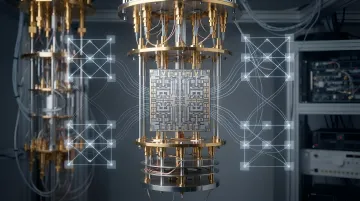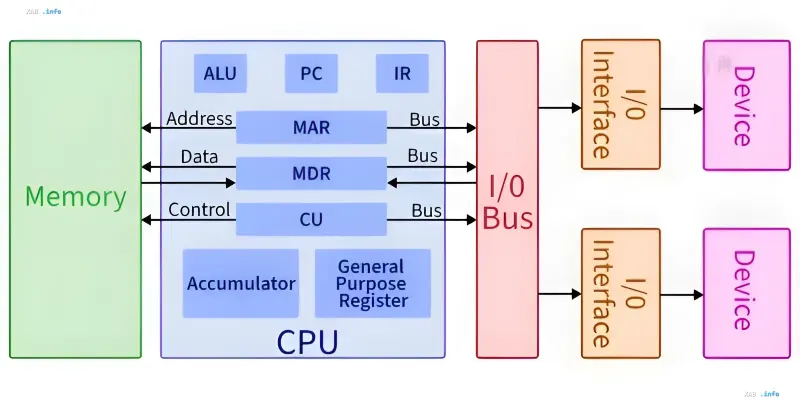
Popular IT publications, when talking about quantum computers, most often draw the prospects and difficulties of creating quantum processors — devices that transform input signals into the output required by the operator. However, even in traditional semiconductor machines, the processor is central, but far from the only component: without memory, where source data, intermediate results, and the final output are stored, the von Neumann architecture itself is unthinkable. The only exception is the simplest non-programmable fixed-program calculators — like basic calculators where the operator inputs data and reads the result themselves, although their logic microcircuits certainly contain register memory cells. Quantum computers differ fundamentally in architecture from von Neumann ones, but the question of whether they need memory in which quantum states should be stored remains open.
Emulator of Nature: When Memory Is Not Needed
If we consider an artificial quantum computer as an emulator of a natural quantum system — for example, when a computer is built to understand the spatial structure of a complex organic molecule — the memory subsystem can indeed be neglected. Quantum computers based on superconducting circuits fundamentally do not contain separate storage nodes: the same hardware components responsible for computations also handle this operation. For now, developers' efforts are focused precisely on improving computing circuits, as modern systems simply lack the time to write and subsequently read quantum states.
Milliseconds of Coherence and Princeton's Achievement
The characteristic duration of a actually implemented stream of continuous quantum computations today is on the order of one millisecond. Last year's achievement by researchers from Princeton University was making tantalum circuits on a silicon substrate maintain coherence for 1.68 ms — a result that no one has yet managed to surpass. By using not oscillatory circuits (artificial atoms) cooled to near absolute zero as physical carriers of quantum states, but fundamentally quantum particles of matter — neutral atoms or charged ions — it is possible to extend coherence retention to seconds and even minutes, but such "natural" computers have their own specifics and scalability problems.
From 12 to 48 Logical Qubits and Beyond
Given the current objective limitation of computing capabilities, complaining about the absence of reliable quantum memory would not be entirely appropriate, but as the "childhood diseases" of early systems are ironed out, the situation is changing. Significantly multi-qubit computers with effective error correction, which allows bypassing the short coherence duration of an individual qubit pair, will urgently need fault-tolerant memory for buffering quantum states. For now, in the absence of quantum memory (though involving conventional semiconductor memory devices in a number of cases), quantum computers successfully solve a narrow range of tasks — binary classification or trusted data transmission.
When Memory Will Become Critical
The true flourishing of the non-von Neumann computing industry is objectively postponed until they acquire quantum memory as well. In 2023, a quantum computer with a dozen logical qubits was created, and by the end of 2025 — already with forty-eight. It is expected that the milestone of two hundred logical qubits will be surpassed after 2029, and it is then that the question of quantum memory adequate to the capabilities of such computers will become especially acute.