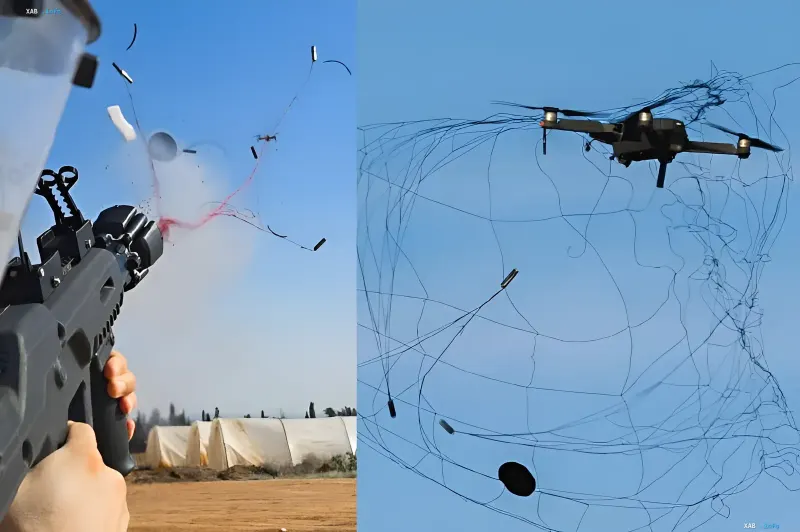
Israeli technology company ParaZero Technologies, specializing in the development of aerospace security systems, has officially unveiled a new robotic active protection system (APS) called DefendAir. The hardware platform is designed to ensure the safety of light and heavy armored vehicles, automobiles, and stationary infrastructure objects from small-sized high-speed unmanned aerial vehicles (UAVs) operating in FPV (First Person View) mode.
The system is positioned by its developers as a lightweight and high-tech alternative to traditional stationary lattice screens and makeshift superstructures, which have become a ubiquitous attribute of modern armored vehicles in recent years.
Technological Architecture and Physical Interception Principle
The operation of the DefendAir complex is based on the integration of a multispectral sensor node and directed launch modules. Unlike heavy metal structures ('mesh screens' or 'grills') that reduce the specific power and maneuverability of vehicles, the Israeli APS is a modular unit with low mass and dimensions.
The interception process is carried out in a fully autonomous mode without the need for operator intervention. When an attacking UAV enters the engagement zone, the system calculates the lead and performs a directed launch of a durable net that unfolds in the air. Upon contact with the net, the UAV's rotors (propellers) are mechanically blocked, causing a loss of lift and subsequent crash of the device without detonation of the warhead upon impact with the protected surface.
Key components of the system and their functional purpose:
- Sensor block: Circular micro-radar, ultrasonic sensors, and optical cameras under AI control.
- Selection algorithm: Automatic identification of high-speed target signatures, trajectory calculation, and filtering of false objects.
- Firing mechanism: Pneumatic or pyrotechnic high-speed firing of the capturing equipment.
- Means of engagement: High-strength polymer net with directed deployment.
Operational Advantages and Safety of Use
The engineering solution applied in DefendAir is aimed at eliminating key shortcomings of modern electronic warfare (EW) means and explosive active protection complexes. First and foremost, the use of a mechanical barrier (net) guarantees the neutralization of an aerial target regardless of the communication frequency used, the presence of interference-protected coding, or the transfer of the UAV to control via fiber optic cable and machine vision systems (autonomous target acquisition).
A critically important aspect is the safety for infantry accompaniment. The non-explosive nature of the interception excludes the formation of a shrapnel field and a directed shock wave, characteristic of heavy tank active protection systems. This allows the complex to be safely operated on vehicles acting in direct tactical interaction with infantry units.
Furthermore, the low weight of the APS modules prevents the shift of the combat vehicle's center of gravity and does not reduce the suspension life, unlike attached steel screens weighing hundreds of kilograms.
Technical and Legal Reference
The implementation of active kinetic protection systems without explosive elements complies with international safety standards for the design of wheeled and tracked vehicles. Industry analysts note a trend of moving from passive armor to local robotic complexes for the detection and physical blocking of small-sized threats in the near zone (up to 10 meters).