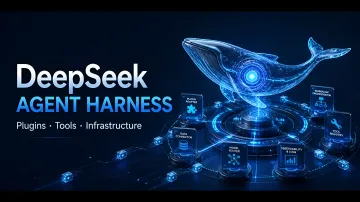
On August 13, 2026, Chinese tech giant DeepSeek made a breakthrough that could revolutionize the AI tool development market. The company officially announced the release of DeepSeek Harness v0.1 in Developer Preview and, following its philosophy of openness, published the source code under the free MIT license. This move marks the beginning of a new era in creating autonomous agents capable of not just generating text but managing complex processes at the operating system level.
"Everything is a Plugin" Architecture: A Revolution in Orchestration
The main feature of DeepSeek Harness is a radical architecture built on the Cordis meta-framework. Unlike the rigid monolithic solutions of competitors, it implements the "Everything is a plugin" paradigm. This fundamental change allows developers to build an AI agent like a LEGO set. In this system, absolutely everything—from neural network models and isolated sandboxes to user interfaces (UI) and orchestration loops—is presented as an independent, replaceable module. This approach offers unprecedented flexibility: any element of the system can be instantly customized or replaced for a specific task without rewriting the core.
The Battle for the Desktop: A Direct Blow to Claude Code and OpenAI
The release of Harness is not just a library update; it is a direct declaration of war against market leaders such as Anthropic (with their product Claude Code) and OpenAI (Codex). DeepSeek is aiming to create a full-fledged autonomous Desktop Agent—an agent capable of working directly on the developer's desktop. Such a tool will be able to autonomously write code, deploy environments, conduct reviews, fix bugs, and automate complex office scenarios. Simultaneously with the announcement, the company launched a public beta and opened the NPM plugin ecosystem, where the official package is available under the name @deepseek-ai/dsh.
Dream Team: The Legacy of Jane Street in AI Development
The seriousness of DeepSeek's intentions is confirmed by the team composition. On the eve of the release, on August 12, it was announced that a dedicated "DeepSeek Harness Team" had been formed. The key architect of the project is Cui Tianyi, who joined DeepSeek in March 2026 from the legendary quantitative trading fund Jane Street. His nine years of experience building high-frequency trading systems with ultra-low latency and high fault tolerance are aimed at making DeepSeek's agent loops the fastest and most cost-effective on the market. This strategic reinforcement of human resources highlights the focus on creating ultra-high-performance systems.
Contradictory Data: Confusion in Naming
In connection with the announcement, some confusion arose within the developer community. On GitHub and in package managers, there exists a library with the same name, deepseek-harness, created by an independent author, Henry Zhang. However, this is a completely different tool: it is written in Python and is designed to help agents like Claude Code work with the DeepSeek V4 API. The official tool from DeepSeek itself is based on the JavaScript/TypeScript and NPM ecosystem. The XAB.info editorial team recommends that developers carefully check repositories and use only the official package @deepseek-ai/dsh to work with the new architecture.
The Philosophy of the "Harness": Why the Framework is More Important than the Model?
Why is DeepSeek betting specifically on a framework rather than a new model? The answer lies in modern trends. Benchmarks from Composio (August 2026) prove that the "harness"—how the environment around the LLM is organized (memory, tool invocation, validation)—affects task success even more than the model itself. The right framework can reduce token consumption by 50% and drastically reduce hallucinations. By open-sourcing Harness, DeepSeek takes control of a critically important layer of abstraction, creating a global standard for the "last mile" between neural network intelligence and real economic utility.