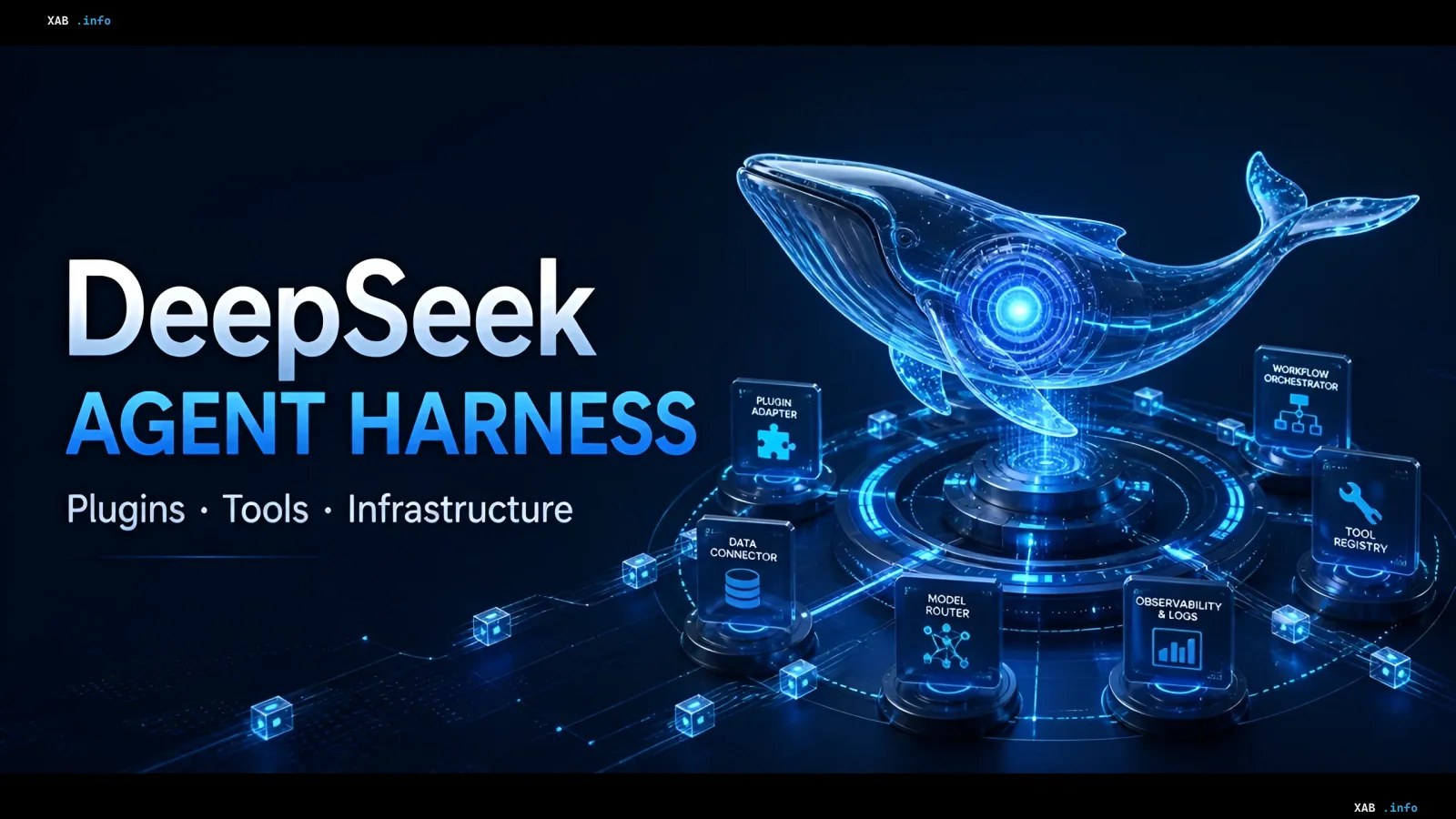
In August 2026, DeepSeek introduced DeepSeek Harness — an open-source framework for developing and running AI agents that prioritizes modularity and flexibility. The tool allows developers to independently swap system components, from models to tools and interfaces, without needing to restart the application. At the core of the project lies the Cordis meta-framework, which supports dynamic plugin management and accounts for dependencies between them.
An Architecture Where Everything Is a Plugin
DeepSeek Harness reimagines the approach to building AI agents by turning not only models but also tools, skills, sessions, sandboxes, file systems, agent loops, and even the interface into plugins. This means developers can easily adapt the system to their needs by replacing individual components without rewriting the entire codebase. Such an architecture is particularly important as competition shifts not only toward the models themselves but also toward agent shells that define how they are used.
Logging as an Analysis Tool
DeepSeek Harness places special emphasis on agent logging. The system saves system instructions, tool calls, results, subagent operations, and context changes in a single unified stream. These logs can be viewed, searched, replayed, and used to continue or branch off a session. This approach gives developers far greater capabilities for analyzing model behavior and debugging complex configurations.
Impact on the Industry
The release of DeepSeek Harness shows that AI competition is gradually shifting beyond just the models themselves. Agent shells determine how models are used, and familiar settings and tools can lock developers into a specific system. Pi creator Armin Ronacher has already called DeepSeek Harness a source of inspiration and admitted that after learning about the project, he wanted to reconsider some of his own decisions. This suggests the tool could become a key benchmark for other developers in the AI agent space.
Contradictory Data
While DeepSeek Harness is positioned as a universal tool for AI agent development, some experts express concerns about its complexity for beginner developers. On one hand, the system’s modularity and flexibility allow for creating complex configurations, but on the other, this may require deep knowledge of architecture and AI agent principles. Additionally, there is currently no data on how quickly the community will be able to adapt and expand the framework’s functionality.
Future Prospects
Given the growing popularity of AI agents and the need for flexible development tools, DeepSeek Harness has all the chances to become one of the key frameworks in this field. However, the project’s success will depend on how quickly the community can adapt it to their needs and how effectively DeepSeek can support and develop the tool in the future.