DeepSeek's Strategic Pivot to Agentic AI
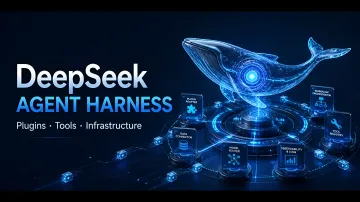
On August 16, 2026, the Chinese company DeepSeek unveiled Harness, a software platform—an innovative solution enabling developers to transform AI models into fully autonomous agents. Built on the Cordis meta-framework, the platform implements the "everything is a plugin" concept: models, tools, skills, sessions, sandboxes, file systems, loops, orchestration, and even the user interface are all modular components that can be freely combined, replaced, and extended without restarting the system.
As experts note, the release of Harness marks a strategic shift in DeepSeek's operations: from creating individual AI models to building foundational digital infrastructure for autonomous agents capable of interacting with external software, executing code, and solving complex tasks without constant human intervention.
Architecture of Dynamic Composability
A key advantage of Harness is its support for dynamic composability—the ability to add or remove plugins on the fly while maintaining system stability. This is critical for environments where modifications occur continuously and human control is minimal or absent. This approach eliminates forced restarts and failures during configuration changes, which is particularly relevant for industrial and research scenarios.
The Cordis service, which underpins the platform, ensures the collaborative operation of plugins by managing their temporal and spatial integration. Developers can flexibly configure agent behavior by selecting the necessary components and adapting them to specific tasks.
Operating Modes and Practical Application
DeepSeek Harness offers four operating modes, each tailored to a specific type of task:
- Standard Mode — for general tasks and everyday use.
- Code-Oriented Mode — allows AI to write and execute code to manage multiple applications simultaneously.
- Creative Mode — designed for experimenting with custom tools and non-standard solutions.
- Minimal Mode — used for isolated component testing in a secure environment.
Following preliminary beta testing, developers noted that Harness provides significantly greater control over AI agent behavior compared to traditional tools, allowing for fine-tuning of decision-making logic and system actions.
Contradictory Data
While SCMP and The Register highlight DeepSeek's strategic pivot towards creating infrastructure for autonomous agents, VentureBeat points out that Harness is positioned as an open-source alternative to Claude Code, while the company also announced the V4-Pro model with higher API prices. This creates a certain ambiguity: is Harness exclusively a tool for developers or part of a broader commercial strategy including paid services?
Furthermore, some sources mention that the platform has already garnered over 122,000 stars on GitHub in three days, indicating high community interest. However, exact figures and testing timelines vary slightly across sources, requiring further verification.
Prospects and Industry Impact
The DeepSeek Harness platform could become a catalyst for the development of a new generation of autonomous AI systems capable of self-learning and real-time adaptation. Its modular architecture opens possibilities for creating specialized agents in various fields—from software development to scientific research and industrial automation.
Given the current trend towards decentralization and modularity in AI development, Harness could capture a significant market share, especially among independent developers and startups seeking flexible and scalable solutions.