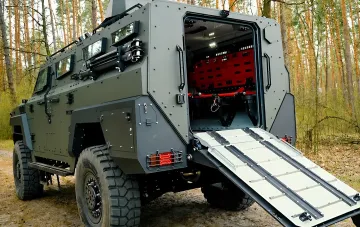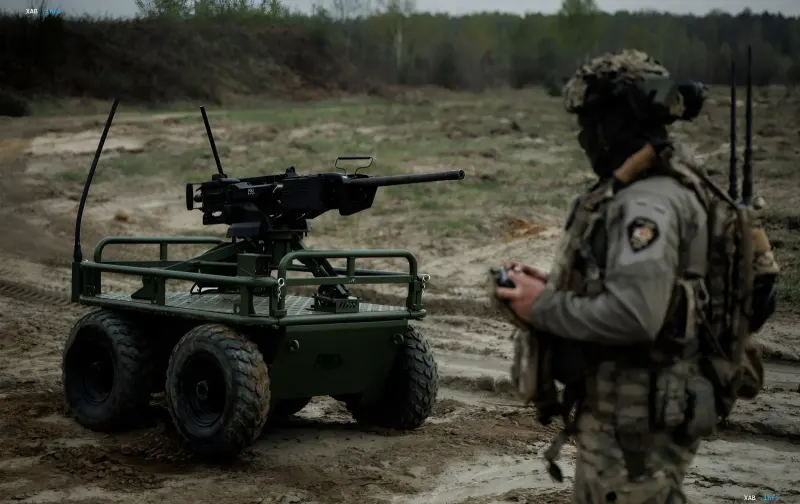
According to an investigation by "Ukrainska Pravda. Defense Industry," cited by RBC-Ukraine, Ukrainian units faced an acute shortage of armored vehicles for medical evacuation in 2026. Meanwhile, the state, albeit with a delay, contracted tens of thousands of ground robotic complexes (GRC), while new contracts for armored cars were virtually not concluded over the course of the year. As military personnel, medics, and defense sector representatives interviewed by the publication note, robots and armored vehicles should not compete with each other but work as parts of a single evacuation system.
Betting on Robots: What the State Procured in 2026
In 2026, ground robotic complexes became one of the key directions for defense procurement. According to business publications, the Ministry of Defense concluded 19 contracts worth approximately 11 billion hryvnias for the supply of GRCs to the Armed Forces of Ukraine, and analysts call robotics a potential new focus of the defense market this year. Thus, the state made a significant bet on autonomous and remotely controlled platforms, hoping to reduce personnel losses at the front.
Medical Evacuation as a System: Why GRCs and Armored Vehicles Are Not Interchangeable
Military personnel explain the logic of two-stage evacuation: in the most dangerous section, a robot picks up the wounded and takes them out of the front-line fire, after which an armored medical vehicle quickly picks up the patient. This approach simultaneously reduces the risk for the crew and allows full-fledged medical assistance to begin earlier. Unlike most ground robots, an armored vehicle allows intensive therapy to begin while in motion: according to medics, armored cars are equipped with ventilators, monitoring systems, external defibrillators, and heart pumps. There were cases where medics began blood transfusions and performed cardiopulmonary resuscitation directly inside the vehicle.
80% Deficit: Assessment of the Medical Service of the 2nd Corps
The most indicative is the assessment of the head of the medical service of the 2nd Corps of the Territorial Defense Forces "Kharta," Bohdan Korylchuk: according to him, the deficit of medical armored vehicles for the second stage of evacuation is currently 80%. Commanders of the 1st Separate Medical Battalion, who directly evacuate the wounded using GRCs, warn that prolonged waiting for evacuation worsens the soldier's condition: due to the delay, deepening hypothermia and hemorrhagic shock develop due to the weakening of the tourniquet. According to them, armor allows the evacuation group to take greater risks if the wounded person's condition deteriorates sharply and they lose consciousness inside the robot capsule.
Limitations of Robots on the Battlefield
At the same time, interviewed military personnel point out the limitations of GRCs. Serviceman and co-founder of the "Center for Aerial Reconnaissance Support" Igor Lutchenko notes that modern GRCs in many cases do not meet the requirements for evacuating live wounded due to low speed and vulnerability. Head of the robotic systems service of the "Da Vinci Wolves" battalion of the 59th Brigade of the Armed Forces of Ukraine, Alexander Yabchenko, adds that even fast robots are not a universal solution: on a real battlefield, their speed is limited by road conditions, terrain, and communication quality. In conditions of expanding the zone of damage from Russian FPV drones, the speed of evacuation and the ability to provide assistance before arriving at the stabilization point directly affect the wounded person's chances of survival.
Contradictory Data
There is a noticeable discrepancy between the official strategy and the assessments of practitioners. On the one hand, the state in 2026 bet on mass procurement of GRCs, viewing them as a tool to reduce losses. On the other hand, direct participants in evacuation emphasize that robots do not replace armored medical vehicles but only complement them, and that the deficit of the latter is critical (the 80% estimate is given by one head of the medical service and is not confirmed by an independent audit). In addition, some of those interviewed point to the technical unpreparedness of many GRCs for evacuating live wounded, which calls into question the thesis about the sufficiency of robotic complexes as the only solution.
Open Question on Production Financing
According to "UP," since the beginning of 2026, negotiations have been held with one of the partner countries regarding the financing of the production of a large number of Ukrainian medical armored vehicles. The publication turned to the responsible Deputy Minister of Defense with a request about the current status of the project, but did not receive an answer. Thus, the question of whether the deficit will be covered by joint production remains open at the time of publication.