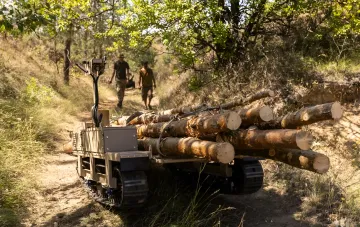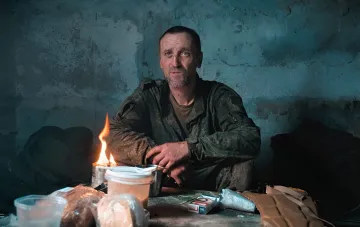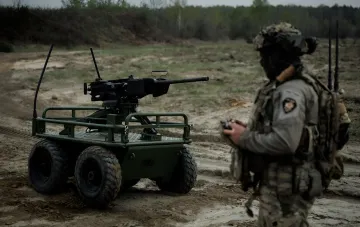
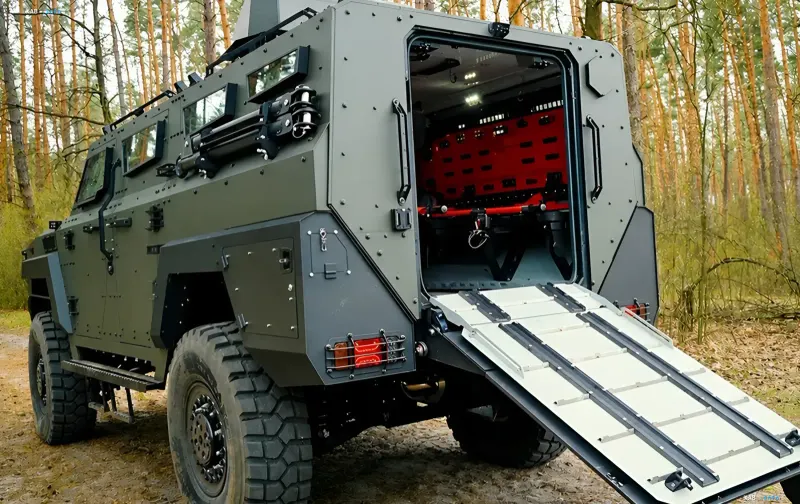
In 2026, the Ukrainian state contracted for tens of thousands of unmanned ground complexes (UGCs), while concluding almost no new contracts for armored vehicles for medical evacuation. This was reported by RBC-Ukraine citing a material from "Ukrainska Pravda. Defense." Against the backdrop of massive robot purchases, military medics and battalion commanders publicly note an acute shortage of armored medical vehicles, which, according to them, are necessary for the second stage of evacuating the wounded from the front line.
Robots and Armor: A Unified System or Competition?
Military personnel emphasize that UGCs and armored vehicles should not compete with each other but work as parts of a unified system. According to the described scheme, on the most dangerous section, a robot picks up the wounded and evacuates them from under the fire of the front line, after which the soldier must be promptly picked up by an armored medical vehicle. This approach, experts claim, simultaneously reduces the risk to the crew and allows full-scale medical assistance to begin significantly earlier.
What Medical Evacuation Practice Says
Commanders of the 1st Separate Medical Battalion note that prolonged waiting for evacuation can significantly worsen a soldier's condition. Unlike most unmanned ground robots, an armored medical vehicle allows intensive therapy to begin while in motion. According to military medics, such armored vehicles are equipped with ventilators, systems for monitoring the wounded person's condition, external defibrillators, and cardiac pumps; there were cases where medics had to start blood transfusions and perform cardiopulmonary resuscitation directly in the vehicle. Armor, moreover, allows the evacuation team to take greater risks if the wounded person's condition deteriorates sharply: "If the wounded person does not come online and loses consciousness in the UGC capsule, then the armored vehicle must come to meet him and provide help sooner," they explained at the battalion.
80% Shortage
The most indicative assessment comes from the head of the medical service of the 2nd Corps of the Armed Forces of Ukraine "Kharta," Bohdan Korylchuk: according to him, the shortage of medical armored vehicles for the second stage of evacuation is currently 80%. "We need enough medical armored vehicles for the second stage of evacuation, and there is currently an 80% shortage," he stated. The head of the robotic systems service of the "Wolves Da Vinci" battalion of the 59th Brigade of the Armed Forces of Ukraine, Alexander Yabchenko, adds that even high-speed UGCs are not a universal solution: on the real battlefield, their speed is limited by road conditions, terrain, and communication quality.
Contradictory Data
Expert positions diverge regarding the role of robots in evacuating the wounded. On the one hand, the military formulate a concept where UGCs and armor are complementary links in one chain, and a robot can indeed carry a wounded person from the front line. On the other hand, Igor Lutchenko, a military officer and co-founder of the "Aerial Reconnaissance Support Center," claims the exact opposite: "Please understand that a modern UGC is usually not suitable for evacuating the wounded! It is a means for evacuating the bodies of the dead, nothing more. It is a solution applied out of desperation, due to the lack of normal means... In this matter, we have a complete functional failure." Thus, one side sees robots as a working element of the first phase of evacuation, while the other sees them as a forced and functionally inadequate replacement, creating a discrepancy in public argumentation and in the logic of the procurements themselves: the state is scaling up the robot fleet but not covering the need for armored medical vehicles.
Negotiations with Partners and Ministry Silence
According to media reports, since the beginning of 2026, negotiations have been held with one of the partner countries regarding the financing of the production of a large number of Ukrainian medical armored vehicles. Journalists turned to the Deputy Minister of Defense responsible for this with a request about the current status of this project, but received no answer. Against this backdrop, the picture remains incomplete: the only publicly confirmed fact is the stated shortage from the military, while the volumes and timelines of possible import/production of medical equipment remain opaque.