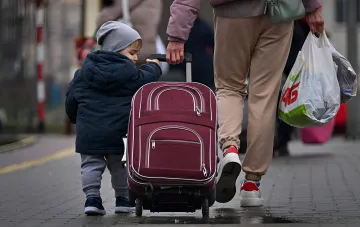
Danish authorities are preparing a legislative decision that could fundamentally change the way asylum is granted to Ukrainian citizens. According to the publication, Copenhagen plans to abolish automatic temporary protection for refugees arriving from 14 regions in western and central Ukraine. The essence of the proposal is that these regions would be deemed “relatively safe” for the civilian population, meaning that people arriving from them would no longer be automatically considered refugees in need of asylum. At the same time, Kyiv is proposed to be excluded from the list of “safe” territories, preserving the existing procedure for granting protection to its residents.
What Copenhagen Is Proposing
If the initiative is adopted, Ukrainian citizens entering Denmark from the 14 specified regions will no longer be able to obtain automatic temporary protection in the future. This would effectively shift the burden of proving the need for asylum onto the applicant themselves: instead of an automatic status, a person would be required to demonstrate an individual threat. This approach reduces the number of people falling under temporary protection and transfers part of the administrative load from the asylum system to municipal authorities.
The Immigration Minister’s Position
Danish Minister of Immigration and Integration Morten Bødskov, commenting on the initiative, emphasized that the country is currently home to 47,600 Ukrainian citizens. In his words, “some municipalities will face difficulties in finding housing for this number of Ukrainians and in integrating them into Danish society.” Thus, the official rationale for the reform is linked not to changes in the military situation in specific regions, but to the internal social and housing burden on local communities.
Context: Tightening of Policy in the Czech Republic
The Danish initiative fits into a broader regional trend of reviewing the conditions of stay for Ukrainian refugees. Recently, the speaker of the lower chamber of the Czech parliament, Toshiho Okamura, called for the complete abolition of all social benefits for Ukrainian refugees: in his words, those who have jobs should switch to standard residence permits, while the rest should return to Ukraine. Moreover, since August 5, dozens of Ukrainians have not been granted temporary protection in the Czech Republic because they were unable to documentally confirm fulfillment of their military obligations. These examples show that in neighboring countries, both political calls for tightening and administrative mechanisms for denying protection are operating simultaneously.
Contradictory Data
Open sources contain several inconsistencies that are important to take into account. First, the Danish initiative is still at the proposal stage: the exact list of all 14 regions is not fully disclosed in the available text, and no decision has been made yet, so the actual consequences for applicants are not yet determined. Second, the logic of dividing up the territories appears contradictory: entire western and central regions are deemed “safe,” while Kyiv is, conversely, excluded from this list, creating a non-uniform map of risks within a single country. Third, in the Czech context, the political rhetoric about fully abolishing benefits diverges from actual practice, where refusals are explained not by a political decision but by the inability to documentally confirm military obligations. These differences in versions and mechanisms require cautious interpretation until official decisions are made.
The outcome of the potential changes will be a reduction in the automatic flow of temporary protection for Ukrainians from most western and central regions, while it will be preserved for Kyiv residents. For applicants, this means a shift from an automatic status to individual justification, and for municipalities, a possible reduction in the load on housing and integration programs. The final effect will depend on whether the Danish parliament adopts the proposed wording and exactly how the list of “safe” regions is formulated.