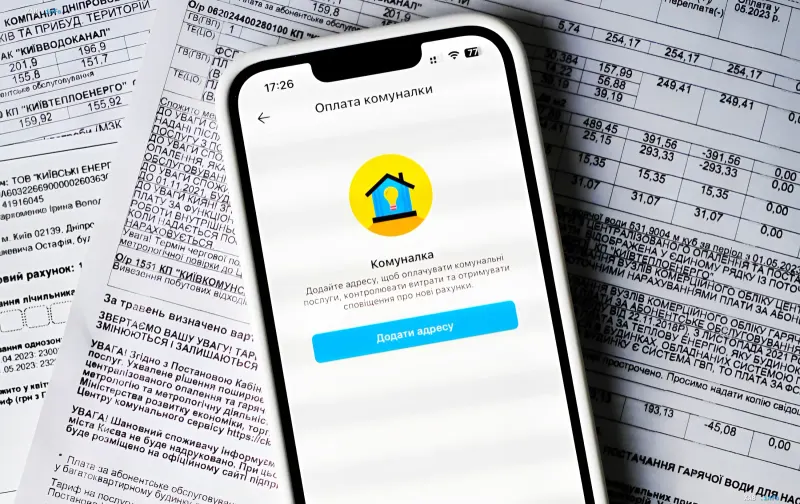
Amidst the ongoing military conflict and mass destruction of infrastructure, thousands of Ukrainians face a paradoxical situation: their homes have been destroyed, yet utility bills continue to arrive. The legal conflict between the actual absence of housing and administrative obligations to service providers requires clear legal regulation. Lawyer and head of the law firm "Prima Leader Group", Dina Dryzhakova, explained to RBC-Ukraine the algorithm of actions for citizens whose housing has been completely destroyed.
Legal Position: Absence of Actual Service Provision
According to lawyers' explanations, the consumer's obligation to pay for utility services arises exclusively at the moment of their actual provision. If the housing is completely destroyed, it is physically impossible to consume water, electricity, or heat; therefore, the obligation to pay ceases. However, service providers often continue to accrue debts automatically, citing the lack of an official contract termination or deregistration. Dina Dryzhakova emphasizes that in such cases, the consumer has the full right to demand the cancellation of unjustified charges.
Action Algorithm: From Application to Court
To stop the accrual of debts, several mandatory stages must be passed. First, the owner must record the fact of the destruction of the housing. This can be done by applying to local authorities, a damage assessment commission, or through documents from rescue services. Second, an official application must be sent to the utility company demanding the cessation of charges and the annulment of the contract. If the company refuses to cancel the amounts in the bills, the dispute is resolved in court. Judicial practice in such cases generally stands on the side of consumers, confirming that payment is impossible without actual consumption.
Contradictory Data
Despite a clear legal position, in practice, there are significant discrepancies in the approaches of utility companies and local administrations. Some service providers require complex document packages, including acts of destruction, which are impossible to obtain under combat conditions. Others, conversely, refuse to recognize verbal statements or photo documentation as sufficient grounds for stopping charges. Furthermore, in some cases, utility companies continue to charge for common household needs even if the building is completely destroyed, creating additional legal conflicts.
Individual Analysis of Each Situation
Lawyer Dina Dryzhakova warns that each situation requires individual analysis. The type of utility service, the date of destruction of the housing, the availability of official confirmation of destruction, and the status of the territory are significant. For example, if the housing was destroyed in a temporarily occupied territory, the procedure for canceling charges may differ from cases of destruction in controlled territories. It is also important to consider that some services, such as a subscription fee for network maintenance, may continue to be charged even in the absence of consumption if the contract has not been officially terminated.
Recommendations for Citizens
Citizens whose housing has been destroyed are advised to act sequentially and document every step. It is necessary to keep all documents confirming the destruction, send official applications to utility companies, and, if necessary, go to court. It is also worth noting that in some cases, compensation for destroyed housing may be available, but this process requires separate consideration and depends on specific circumstances and legislation.