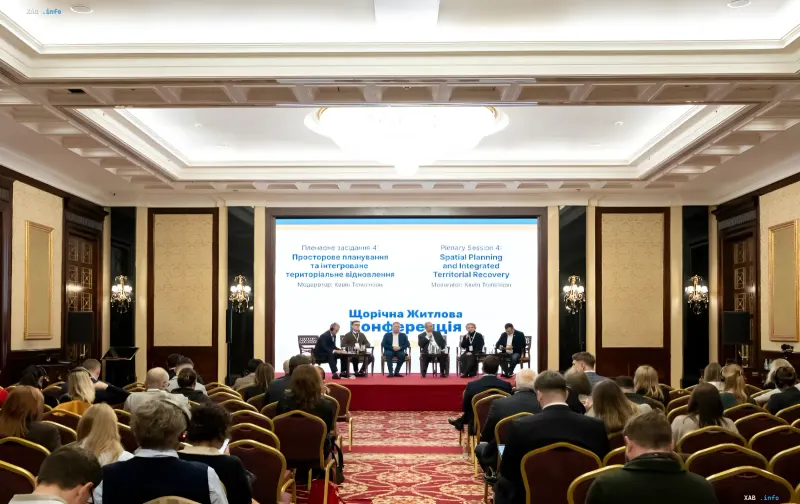
At the Annual Housing Conference 2026, during the plenary session «Spatial Planning and Integrated Territorial Recovery», representatives of parliament, local communities, the development business, and the World Bank Group discussed a key issue of Ukrainian housing construction: how to ensure its development under conditions of limited state funding, complex urban planning regulations, and large-scale recovery needs. The central thesis of the discussion was the assertion that the resource to solve these problems «lies underfoot» — in the form of unused post-industrial territories which, with proper organization, can become a source of hundreds of millions of dollars in investments and tax revenues.
Three Systemic Problems and One Answer
Yevhen Favorov, Head of the Ukrainian Association of Developers, structured the problem into three blocks: a shortage of funds for developing urban planning documentation, limited effectiveness of existing regulatory mechanisms, and an acute need of local communities for private investments. According to him, all three problems have a single solution — partnership with the development business. «I have an answer to all these three problems. The only answer is development. I am sure that each of these problems can be solved through cooperation with business», — Favorov emphasized. He also pointed out recent legislative changes that have given developers a direct opportunity to finance the development of urban planning documentation, which was previously unavailable.
300 Million Dollars for Plans That Do Not Exist
The scale of the task facing local communities is illustrated by the estimate of Ivan Slobozhanyk, Executive Director of the «All-Ukrainian Association of Communities»: developing comprehensive spatial development plans across Ukraine may require about 300 million dollars. At the same time, communities face rigid budget expenditure constraints, a reduction in donor support, and a shortage of qualified specialists. Member of Parliament Anna Bondar, in turn, drew attention to the need for further development of urban planning legislation after the adoption of the law «On the Basic Principles of Housing Policy», in particular — mechanisms for land reservation, taking into account various housing formats in urban planning documentation, and resolving land issues for multi-apartment buildings. «We must look for ways out of the crisis we have fallen into», — she noted, emphasizing the urgency of developing and approving urban planning documentation.
1700 Hectares of Potential: What Lies Beneath Industrial Zones
Favorov associates the greatest potential for attracting investment with the revitalization of post-industrial territories — former factories, industrial zones, and large unused plots within city limits. As a benchmark, he cited data prepared during the development of the draft new General Plan of Kyiv in 2015: city authorities estimated the area of industrial territories in need of transformation at approximately 1,700 hectares. Although this document was never approved, the estimate demonstrates the scale of the capital's potential for implementing hundreds of complex development projects. By analogy, these data can be extrapolated to other major cities of Ukraine, where similar reserves of abandoned industrial territories are also significant.
The Economics of One Hectare: Calculation on 10 Hectares
To assess the potential economic effect of developing post-industrial territories, the Ukrainian Association of Developers prepared a calculation based on the practical experience of member companies. As an example, a complex project on a former industrial site of 10 hectares was taken. According to preliminary estimates, about 3,000 apartments with a total area of 175,000 square meters, as well as another 100,000 square meters for business objects, social, and other infrastructure functions, can be built in such an area. Investments in such a project will amount to about 275 million dollars — which, according to Favorov, is essentially the averaged cost.
56 Million Dollars in the Budget: How the Multiplier Works
Out of the total investment amount, about 20.6 million dollars will go to external engineering networks, which the city will receive for free; 41.25 million dollars — for wages; taxes and social contributions will amount to about 18.6 million dollars. The total budget effect, including VAT, is estimated at approximately 56 million dollars. However, as Favorov emphasizes, these are only direct revenues. These funds will be used to purchase materials, equipment, transport, and other goods and services — these are orders for enterprises and work for people far beyond the construction site itself. «This is how the economic multiplier works», — noted the head of the Association, pointing out the additional indirect effect that significantly exceeds direct tax revenues. Thus, a development project on a single former industrial zone is capable of bringing an amount comparable to the annual funding of a whole range of infrastructure programs to the state and local budgets.
The discussion at the plenary session showed that the main barriers to realizing this potential are not economic, but regulatory in nature: the absence of approved general plans, unresolved land relations, and outdated mechanisms of interaction between communities and business. The legislative changes adopted in 2025–2026, allowing developers to finance urban planning documentation, became the first practical step, but according to conference participants, further amendments and, most importantly, political will at the level of local and central authorities are necessary for a systemic effect.