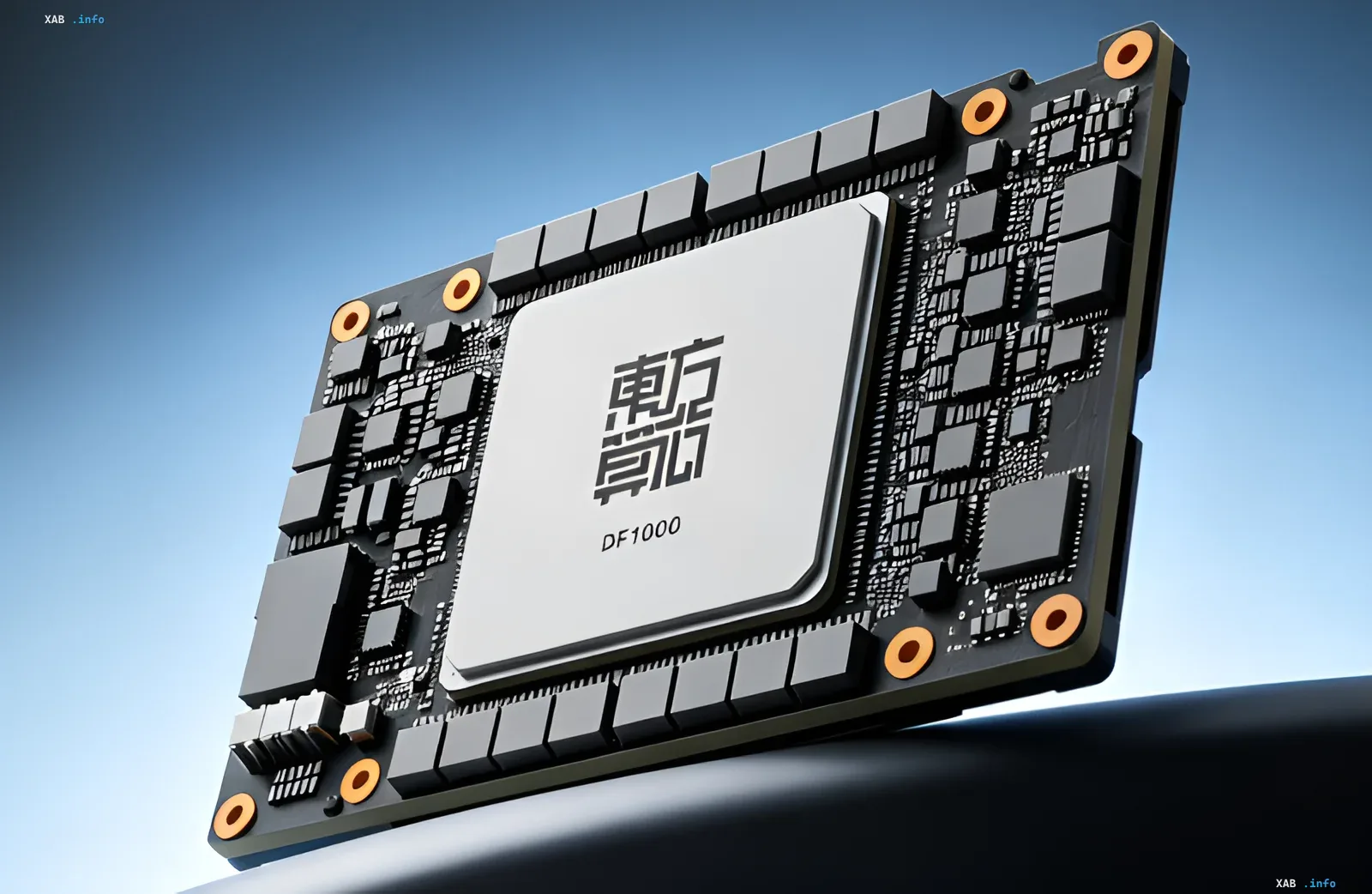
The artificial intelligence market has gained a new serious player. Chinese company Dongfang Suanxin (Shanghai Oriental Compute Core Technology) has officially unveiled its flagship AI accelerator — the DF1000. The new product is developed entirely on domestic components and offers a unique solution to the shortage of expensive HBM memory by employing its own 3D DRAM technology instead.
"Near-In-Memory Computing" Technology
The key feature of the DF1000 is the use of a "Near-In-Memory Computing" architecture. The device is based on a multi-layer 3D DRAM chip created using hybrid bonding technology. The company's engineers claim that this approach allowed them to radically reduce the interconnect pitch — from the micrometer to the sub-micrometer level.
Such miniaturization has led to a tenfold increase in the number of through-silicon vias compared to traditional solutions. The result is a fivefold increase in memory bandwidth while maintaining the same capacity. In effect, this allows for the creation of an effective analog of high-performance HBM memory without actually using it.
Specifications and Performance
The DF1000 accelerator is manufactured using a 14nm process. Despite the use of a mature process, the hardware specifications look impressive:
- Memory bandwidth: 6.4 TB/s.
- Scalable interconnect bandwidth: 900 GB/s.
- Computing power: 520 TFLOPS in BF16 mode.
The flexibility of the architecture allows the hardware to be reconfigured for specific tasks, which significantly improves resource utilization efficiency. The device is positioned as a tool for training large language models (LLMs) and performing other compute-intensive tasks.
Comparison with Market Leaders
According to the manufacturer, the DF1000 demonstrates impressive results compared to NVIDIA products. The claimed bandwidth of the Chinese accelerator is twice that of the NVIDIA H100 model and exceeds the performance of the newer H200 accelerator by 33%.
In practical tests with the Llama3 70B model, the device shows a generation speed of up to 500 tokens per second, confirming its suitability for working with modern neural networks.
Development Plans: DF2000 and DF3000
Dongfang Suanxin has already announced a roadmap for the development of its accelerator line. The next step will be the release of the DF2000 model, scheduled for 2027. It will also be built on 14nm technology but will offer the following specifications:
- Memory bandwidth up to 15 TB/s.
- Interconnect up to 1600 GB/s.
- Performance: up to 1000 TFLOPS (BF16), 2000 TFLOPS (FP8), and 4000 TFLOPS (FP4).
The final stage at this time is the DF3000 model, scheduled for release in 2028. It promises to double the computing power of its predecessors, providing up to 2000 TFLOPS in BF16 mode and memory bandwidth up to 20 TB/s. These plans indicate the company's intention to secure a strong position in the high-performance computing market in the coming years.