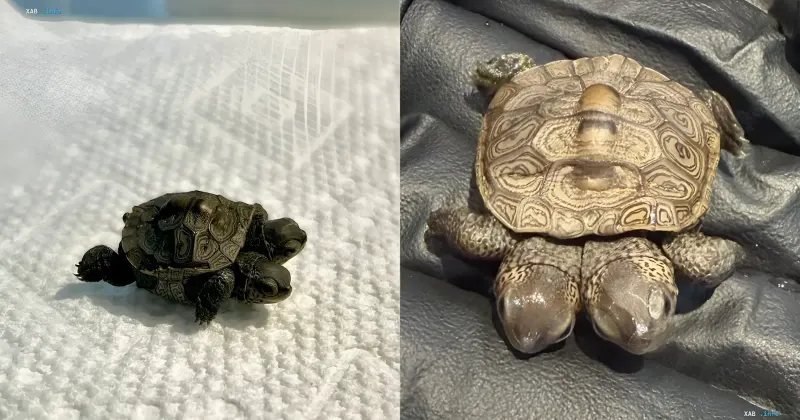
In Cape Cod, Massachusetts, USA, an extremely rare case of developmental anomaly in reptiles has been recorded: wildlife conservation specialists have received a baby diamondback terrapin featuring two fully functional heads on a single body. According to the center, this malformation is known as dicephalism and occurs when two working heads develop on a shared body during the growth process. The discovery came as a surprise to the rescue team and drew close attention from veterinarians, who are now systematically monitoring the animal.
How the Turtle Reached the Specialists
The baby diamondback terrapin was transferred to the Cape Cod Wildlife Center from the Wellfleet Bay Wildlife Sanctuary, which belongs to the Mass Audubon organization, for care and medical observation. Upon arrival, the animal weighed only 5.2 grams, and its body was so small that its width was approximately equal to two fingers placed side by side. It was during the examination that rescuers noticed the turtle had two heads, both of which proved to be functional, determining the subsequent approach to working with the patient.
What Dicephalism Is and How It Is Monitored
Dicephalism, or two-headed deformation, is an anomaly in which an organism develops with two working heads on a single body. Center veterinarians are currently closely studying how the two heads interact with the shared body, while also recording the animal's feeding habits, growth rates, and daily activity. The coordination of movements between the two heads and how they share feeding and spatial orientation functions are key aspects of the ongoing observation, allowing specialists to better understand the anatomical structure and functioning of such an organism.
How Rare This Phenomenon Is
According to the Cape Cod Wildlife Center, specialists have recorded only two additional cases of two-headed animals over the past five years, underscoring the extreme rarity of this phenomenon. At the same time, each such case, even with prior experience, gives experts an opportunity to learn more about anatomy and bodily function. An additional factor drawing attention to this patient is the species' status: diamondback terrapins are an endangered species in Massachusetts and are listed as protected under the state's Endangered Species Act, keeping the animal's condition under the oversight of conservation groups.
Previous Case: A Turtle with Six Legs
Earlier, in October 2021, the New England Wildlife Center received a report about another two-headed diamondback terrapin. That specimen, in addition to two heads, had six legs, and its body was divided more distinctly than in the recently discovered animal. Experts at the time described this condition by analogy with conjoined twins in humans, where two organisms share body structures while simultaneously possessing separate organs or parts. Although animals with such deformations frequently face difficulties and challenges affecting their quality of life and lifespan, in the case of the 2021 turtle, its condition at one point instilled a certain amount of optimism in the veterinarians.
What Comes Next
Currently, the priority for the team of specialists remains monitoring the feeding habits, growth rates, and movement coordination of the two heads of the newly arrived turtle. As in previous cases, each such patient becomes the subject of long-term study, deepening the understanding of rare developmental anomalies. The combination of the extremely low frequency of such cases and the protected status of the species makes this observation significant not only from a medical standpoint but also for wildlife conservation in the state of Massachusetts.