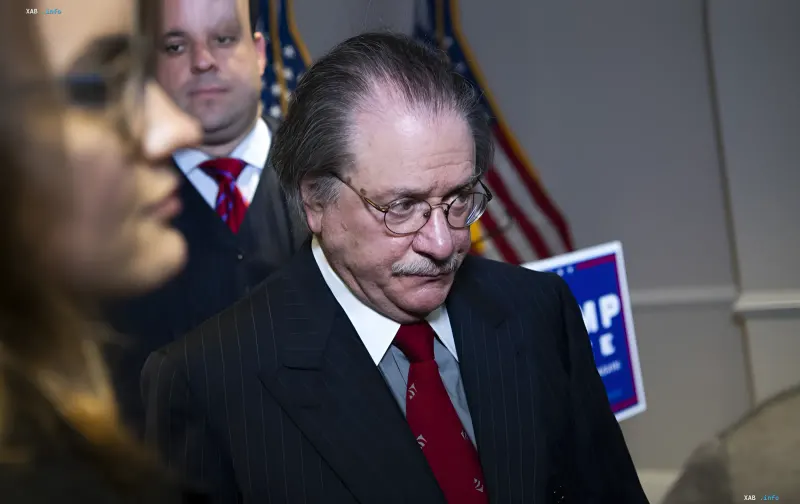
U.S. prosecutor Joseph Digenova, who headed a sweeping investigation aimed at Donald Trump's opponents, has announced his resignation. He told the Reuters news agency of his departure without revealing the reasons behind it. "It was an honor and a privilege to serve the president and the department," Digenova said, declining further comment. His departure leaves one of the most high-profile cases in American jurisdiction in a state of deep uncertainty.
Who Is Joseph Digenova and Why He Took the Lead on the Investigation
Digenova is a longtime ally of President Trump and a former U.S. Attorney in Washington during the Ronald Reagan administration. In April 2026, he joined the Department of Justice to head an investigation based in Florida. Since his appointment, he has consistently repeated the president's claims that the Russia case was a politically motivated attempt to harm Trump.
What Exactly Was Under Investigation
The investigation covered several key areas. First, it examined the 2017 U.S. intelligence assessment that Russia had attempted to support Trump's first presidential campaign in 2016. Second, it brought into focus the cases of former special counsel Jack Smith — over Trump's retention of classified documents at Mar-a-Lago and over attempts to contest the results of the 2020 election. The investigation's stated objective was to prove that the president had been the victim of a prolonged criminal conspiracy by his political opponents.
Results and Legal Obstacles
Despite extensive efforts, the investigation did not lead to any criminal charges. Investigators interviewed current and former intelligence officials, and in recent weeks attempted to question FBI officials involved in the 2022 Mar-a-Lago search. At the same time, a number of lawyers have expressed doubt as to whether prosecutors can even bring a case in Florida, given that a significant portion of the Russia-related investigation took place in Washington and Virginia.
Broader Context: Pressure on Opponents
Digenova's investigation is part of broader Department of Justice efforts directed against the president's likely opponents. Some of Trump's allies had hoped that the investigation's findings could lead to charges against former special counsel Jack Smith, former CIA Director John Brennan, and former FBI Director James Comey, against whom the administration has already brought charges in two other cases. In August 2026, the White House declassified FBI materials on a secret 2017 investigation into possible Trump links with Russia — opened after the firing of FBI Director James Comey and later closed without finding evidence.
Contradictory Data
There is a notable gap between the expectations of the president's political allies and the actual results of the investigation. On the one hand, part of Trump's circle had expected the arrest of senior officials — Smith, Brennan, and Comey. On the other hand, no charges were filed during the course of the investigation, and its head resigned without revealing the reasons. Moreover, the legal community points to potential procedural obstacles: the jurisdiction of a Florida court may not extend to events that occurred in Washington and Virginia, which calls into question the very possibility of bringing a case based on the work carried out. Thus, the mismatch between political ambitions and legal realities remains the central contradiction of the entire story.