Every day we open links from acquaintances, trust messages in messengers, and automatically log into our work email, bank, and cloud documents. It is precisely this trust and habit of acting on "autopilot" that make us most vulnerable online today, explains Ruslana Korenchuk, CEO of Diia.Education, CDTO Campus, and manager of joint projects between the Ministry of Digital Transformation and the Eastern Europe Foundation, in a column for RBC-Ukraine.
Certainty as the primary vulnerability
According to a digital and AI literacy study, among those who do not consider developing digital skills relevant, 55% answer: "I already know everything." In 2019, 38% said this. The expert emphasizes that certainty is based on past experience, whereas the internet changes faster than we can comprehend it. A key digital literacy skill today is the ability to doubt what we think we already know.
Skills are growing, but vulnerable users too
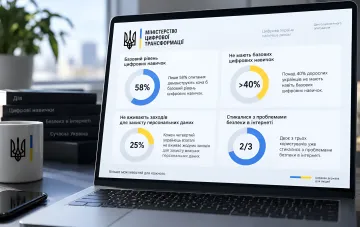
Basic digital skills are now possessed by 58% of adult Ukrainians, compared to 47% in 2019. At the same time, the proportion of people with low skill levels, which had been declining for several years, returned to the 2019 figure of around 38%. Researchers attribute this to new users coming online who are just starting to develop their skills. According to the same data, 67% of internet users encountered security issues over the year: phishing, messages from hacked accounts of friends, and fake websites. One in four takes no security measures at all, and only a third feel safe online.
AI changes the rules of social engineering
While scammers used to be betrayed by text errors, by early 2025 more than 80% of social engineering attempts worldwide already used artificial intelligence, according to the EU Cybersecurity Agency ENISA. Messages have become well-written and personal, and a voice can be faked in seconds of recording. According to the study, 44% of Ukrainian users received requests to transfer money via a friend's hacked account over the year. Meanwhile, 42% of adult Ukrainians use AI: half rely on its advice when making decisions, and a third noticed over six months that AI makes up facts.
European context and the 2030 target
The challenge is not limited to Ukraine. According to Eurostat, about 40% of people in the EU still lack basic digital skills, and the bloc's goal is for 80% of adults to have such skills by 2030. Ukraine is moving toward the same benchmark.
"Digital Literacy Month" and Hygiene Hyena
Since 2021, together with the Ministry of Digital Transformation, the "Digital Literacy Month" initiative has been held, growing out of the pan-European All Digital Week campaign. The face of the campaign became Hygiene Hyena, a character who falls into the same traps as ordinary users: voting in suspicious contests, believing in sudden winnings, and postponing phone updates. The campaign reached 4.1 million people and won two bronze awards at the Kyiv International Advertising Festival and the ADC*UA Awards. At its center is the free educational series "Digital Skills and Online Safety."
The expert's conclusion is simple: digital literacy is not programming or knowing terminology, but the habit of checking the source, doubting a "familiar" voice, and not making decisions on autopilot. It is this habit, she says, that protects best today.