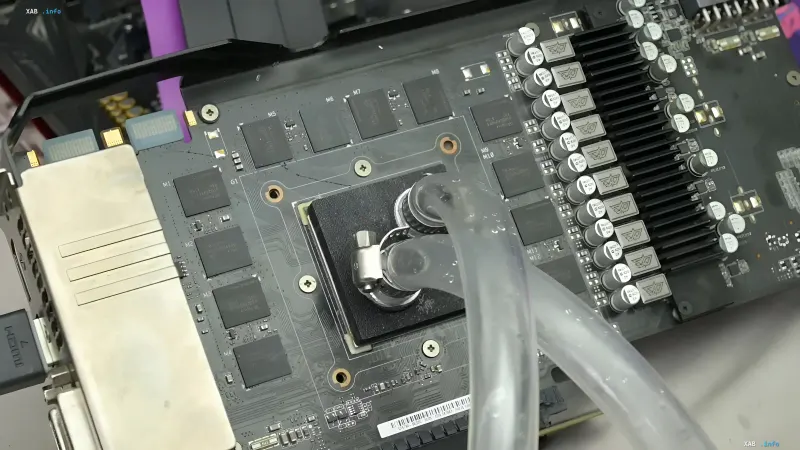
In the world of computer enthusiasm and modding, new ways to overcome the thermal limitations of silicon chips are constantly being sought. Recently, the well-known modder TrashBench presented the results of his latest experiment, which can be called extreme. Instead of using traditional heatsinks or even water blocks, the modder directed a stream of water directly onto the exposed die of a GeForce RTX 2060 graphics processor. The result was impressive: the GPU temperature under load dropped to 28 °C, which is 42 degrees lower than the stock cooling performance.
Evolution of the experiment: from 3D printing to sealing
The path to this result was not easy and began with testing the idea on an already faulty GeForce RTX 3060 video card. To implement the concept, TrashBench created a special plastic housing printed on a 3D printer that surrounded the exposed die. A critically important stage was sealing the substrate surface with an epoxy compound. The first prototypes of the structure suffered from leaks, which forced the author to rework the system several times to ensure reliable isolation of the electronics from the water.
Comparative tests: from 70 °C to 28 °C
After the sealing issues were resolved on the GTX 980, the final experiment was conducted on a fully functional GeForce RTX 2060 video card. In the Unigine Heaven test with the stock heatsink, the card heated up to 70 °C. When using a classic liquid cooling system with a 360mm radiator, the temperature dropped to 36 °C. However, when the heatsink and water block were dismantled, and the pump began to supply water directly to the surface of the GPU, the core temperature dropped to 28 °C. At the same time, the hottest spot on the chip reached only 41 °C.
Contradictory data
Although the video card experiment showed phenomenal results, a similar approach did not yield the same success on processors. TrashBench repeated the experiment with an Intel Core i5-7600K processor, but in this case, the focus on direct water supply did not allow him to surpass the indicators of a standard liquid cooling system. This indicates that the efficiency of the method depends directly on the architecture of the specific chip and the design of the supply system. Unlike GPUs, where heat dissipation is concentrated in one point, processors may have different thermal profiles requiring uniform distribution of liquid pressure.
Technical risk and practical applicability
Despite the impressive figures, such a scheme is absolutely unsuitable for the average user. The water in this structure is in immediate proximity to the die, substrate, memory chips, and other components. Even minimal leakage or a micro-crack in the insulation can instantly destroy the video card or disable the entire computer system. The experiment serves more as a demonstration of the physical limits of liquid cooling efficiency, confirming that the closer the liquid is to the heat source, the more effective the energy dissipation.