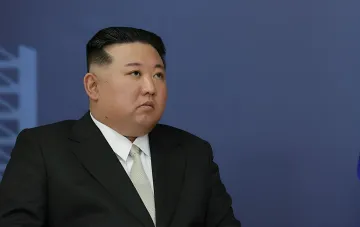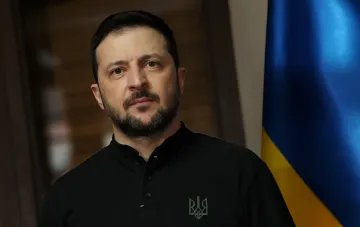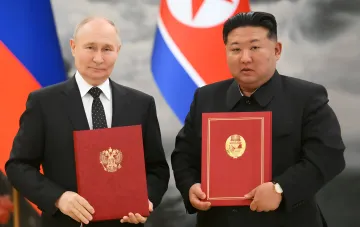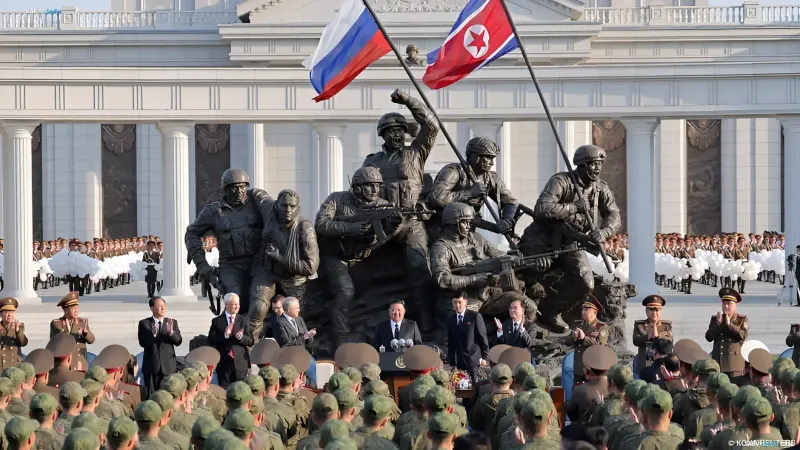
In August 2026, Ukrainian President Volodymyr Zelenskyy stated that the deployment of 30,000 to 50,000 North Korean soldiers to Russia was expected in the near future as part of Pyongyang's ongoing support for Moscow. By mid-November, no such event had occurred, and for analysts, the question remains whether the DPRK intends to send its combat units to the Russian Federation again. Experts, including those interviewed by the German broadcaster DW, agree that North Korea is deliberately limiting its involvement in combat operations while maintaining its alliance with Moscow.
The request for 30,000 and the failed summit
On November 9, Andriy Kovalenko, the former head of the Ukrainian Center for Countering Disinformation (CCD) of the NSDC, who left his post in September, reported via Telegram that according to an intelligence assessment prepared in August, the Kremlin had requested more than 30,000 North Korean troops for an autumn offensive in Ukraine. According to him, a summit between North Korean leader Kim Jong Un and Russian President Vladimir Putin, which was expected in September, never took place. Kyiv authorities emphasize that North Korea had already sent thousands of its soldiers to Russia in 2024, when the Russian Federation was conducting combat operations in the Kursk region to push out the Armed Forces of Ukraine.
The "red line" of offensive operations
Kovalenko believes that Pyongyang rejected Moscow's new request because participating in offensive operations on the Russian-occupied territories of Ukraine's Donetsk region may still remain a "red line" for North Korea. At the same time, according to his assessment, Russia remains dependent on material support from the DPRK, primarily munitions supplies. The expert estimates the probability of a new large-scale deployment of North Korean combat units to the Russian Federation this winter as low.
Winter and the decrease in combat intensity
Han Gi-bom, a former deputy director of South Korea's National Intelligence Service, explained to DW that the decrease in combat intensity and the onset of winter give Pyongyang little immediate reason to send new troops to Russia. A visit to Moscow last week by Jo Yong-won, a member of the Presidium of the Politburo of the Central Committee of the Workers' Party of Korea and a close associate of Kim Jong Un, may shed light on future plans. According to Han, it is not yet clear whether the purpose of the trip was to deepen political ties between the ruling parties in addition to military cooperation or the direct preparation of a visit to Moscow by the North Korean leader himself.
What remains in Russia and what Pyongyang receives
An Chan-il, a former North Korean soldier who defected to the South in 1979 and now heads the Seoul-based World Institute for North Korean Studies (WINKS), notes that the Russians also have reasons to limit the deployment of North Korean troops: Moscow will weigh its needs on the battlefield against the costs of involving additional military personnel from the DPRK and is unlikely to request a new contingent unless the conflict scales up. According to Kovalenko, a unit of North Korean rocket specialists remains in the Voronezh region, and about 8,500 DPRK troops from support units, including drone operators, engineers, and sappers, are in rear areas. On November 17, Zelenskyy wrote that Russia receives dozens of ballistic missiles from North Korea monthly, and their use in Ukraine helps Pyongyang improve its weapons while creating risks for countries around the Korean Peninsula.
"Deterrence strategy" and prospects for cooperation
According to Kovalenko's assessment, Pyongyang is pursuing a course he called a "deterrence strategy": North Korea is limiting its involvement in the war on Russia's side while maintaining relations with both Moscow and Beijing, which allows it to preserve the benefits of its alliance while reducing dependence on the outcome of the conflict. WINKS head An Chan-il predicts that military cooperation will continue, as aid to Russia is crucial for developing UAV technologies and strengthening the DPRK Navy; however, the scale of this cooperation will depend on the dynamics of the fighting and the decisions Pyongyang makes after upcoming contacts with Moscow.