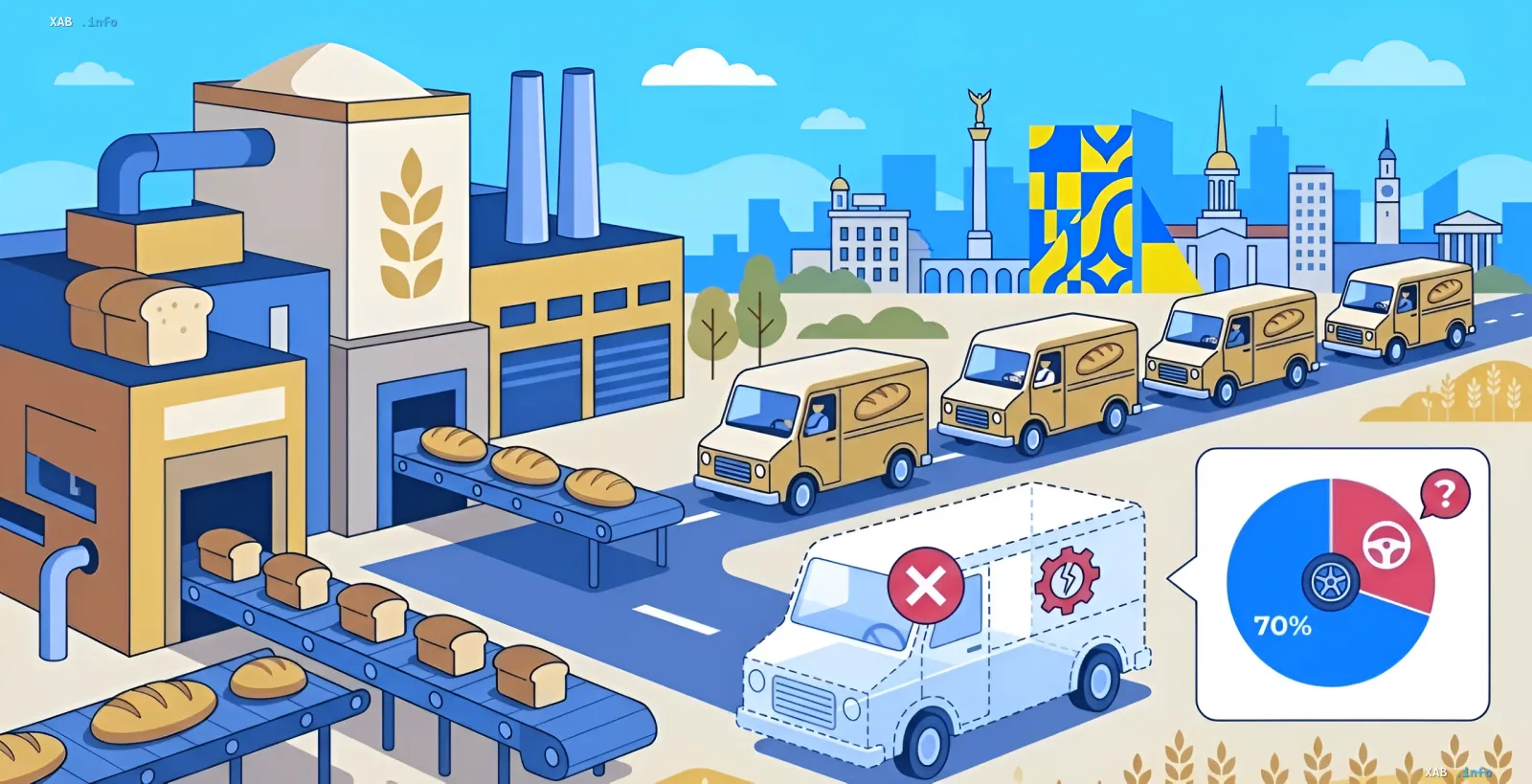
August 12, 2026 — the date when Ukraine's food security faced a new, hidden threat. While the world previously focused on the state of fields and power grids, the focus has now shifted to logistics. The All-Ukrainian Association of Bakers has voiced an alarming figure: there is a colossal shortage of drivers at bakeries across the country — approximately 30% of the staff. This is not just a staffing issue; it is a risk of disrupting the delivery of the most basic food product to retail chains.
Logistical Collapse: When "Daily Bread" Cannot Reach the Shelf
The situation described by Alexander Taranenko, the First Vice-President of the All-Ukrainian Association of Bakers, appears critical. The shortage of drivers for specialized transport has forced the redistribution of logistical routes. As a result, systematic delays in the distribution of finished products are being recorded at many bakeries. This creates a risk that fresh baked goods will not be delivered to stores on time, which, given high inflation and shortages, could trigger local panic buying.
The problem is exacerbated by the fact that remaining employees are forced to take on double the workload. The average monthly workload for a single driver has reached more than 340 hours. For comparison, a standard working month is about 160–170 hours. Such a schedule effectively means that drivers are working without days off, spending days on the road, which inevitably leads to physical exhaustion and an increase in road accidents.
Deferrals and Mobilization: The Thin Line Between Production and the Front
The key factor influencing the staffing situation remains the martial law and mobilization rules. According to the Resolution of the Cabinet of Ministers of Ukraine No. 76, food industry enterprises classified as critically important have the right to deferment (brony). However, the limits are strictly regulated: deferment from conscription is provided for no more than 50% of the military-liable employees.
This regulatory threshold has become a stumbling block for the industry. Industry representatives point out that incomplete coverage of the logistical link by the deferment procedure creates risks for the regularity of supplies. If half of the drivers go to the front, and the other half works to the point of burnout, the system begins to fail. In conditions where 20% of the industry's production capacity has already been damaged by strikes on infrastructure, the loss of logistical resources could be fatal for many enterprises.
Contradictory Data: Reality vs. Statistics
Although the Bakers' Association cites a shortage figure of 30%, there are different assessments of the scale of the catastrophe within the industry. On the one hand, the association's official data relies on reports from large holdings where personnel accounting is strict. On the other hand, private bakeries and small manufacturers report an even more dire situation, where the shortage may reach 50–60% due to the lack of legal deferment opportunities for small businesses.
Furthermore, there is a gap in the perception of the "norm." For the state, 340 hours of work a month may be viewed as a temporary measure in emergency conditions; however, trade unions and occupational health experts insist that this exceeds human physiological limits and leads to a hidden loss of product quality. While government agencies speak of "stability," industry players are recording a rise in staff turnover that cannot be compensated by new hires.
General Context: Staff Shortage as a National Problem of 2026
The problem at bakeries is just the tip of the iceberg. According to sociological studies and recruitment platforms, in the third quarter of 2026, up to 78% of Ukrainian employers are recording a staff shortage in the manufacturing, construction, and transport sectors. This is a systemic crisis affecting the entire economy.
Recruiters note that finding a driver with experience on specialized transport is becoming harder than finding an engineer or IT specialist. The reasons lie not only in mobilization but also in migration processes, as well as the fact that many specialists prefer to work in safer regions or switch to remote work. In conditions where logistics is the circulatory system of the economy, its blockage due to a lack of personnel poses a threat not only to bakers but to the country's entire food security.