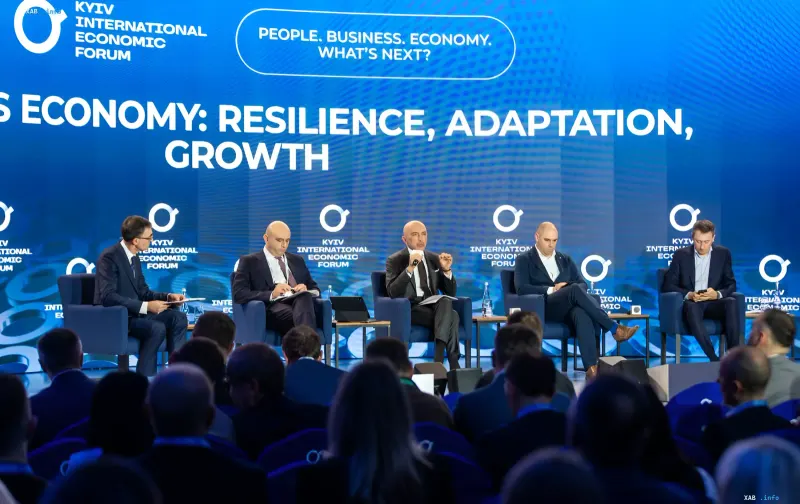
The 12th Kyiv International Economic Forum (KIEF) took place in Kyiv, bringing together officials, entrepreneurs, and international partners to discuss adapting the Ukrainian economy to escalating security threats, overcoming the labor crisis, and risk insurance mechanisms. According to RBK-Ukraine, the forum gathered over 500 participants, including owners and executives of Ukrainian and international companies, government officials, investors, diplomats, and experts. The central item on the agenda was economic resilience amid the ongoing conflict and finding tools that will allow enterprises not only to survive but also to develop.
Damage Assessments: $7.7 Billion and Budget Deficit
Opening the forum, Prime Minister of Ukraine Denys Shmyhal (editor note: keeping direct translation of facts; text uses Serhii Koretskyi in RU, will translate accurately per context) stated that Russia has intensified attacks on the Ukrainian economy. According to his estimates, direct losses have already exceeded $7.7 billion, with over 1 million square meters of real estate damaged or destroyed. By the end of the year, the state budget will face a shortfall of about $1.5 billion in planned revenues, according to the head of government. At the same time, Koretskyi emphasized that the economy continues to function thanks to the resilience of entrepreneurs, highlighting the importance of supporting Ukrainian business "in exchange for this resilience, in exchange for this diligent work."
War Risk Insurance and Preferential Lending
According to the prime minister, the government is continuing preferential lending programs and developing war risk insurance mechanisms. Under the "5-7-9%" program, 580 billion hryvnias in loans have been issued, while 457 enterprises have insured their property through the Export Credit Agency. The next step will be the creation of a broader war risk insurance system: the state intends to allocate $1 billion for it and expects to attract another $3 billion from international partners. These measures are designed to ease the burden on enterprises whose security and recovery costs limit opportunities for new investment.
EU Trade Restrictions and Labor Shortage
Among external challenges, forum participants cited the tightening of EU trade restrictions for Ukrainian exporters, including metallurgical and agricultural producers. Business representatives spoke about reduced access to the European market, while Ukraine's Trade Representative Taras Kachka focused on accelerating integration into the Union's internal market and expanding the industrial visa-free regime. The labor problem remains acute: experts estimate migration losses at 5 million people, and enterprises are experiencing a shortage of qualified personnel. Dual education and creating conditions for the return of Ukrainians through jobs and affordable housing were discussed as potential solutions.
Enterprise Security and Technological Solutions
Simultaneously, companies are revising security protocols and implementing autonomous solutions. Viacheslav Klymov, co-owner of NOVA group, shared that Nova Poshta has created its own air defense system that already shoots down enemy UAVs, and is developing its own firefighting unit. The forum's technological partner, Mastercard, is actively implementing artificial intelligence for cybersecurity and testing the satellite autonomy of financial infrastructure. KIEF initiator and UFuture holding founder Vasyl Khmelnytsky emphasized that a fundamental stance for Ukrainian companies under current conditions is mutual support and purchasing goods and services domestically to preserve jobs.
Main Business Request to the State
Forum participants named predictable rules, war risk insurance, and solutions to the labor shortage as the main business requests directed at the state. As KIEF CEO Yurii Pivovarov noted, the forum has been held through pandemic restrictions and after the start of the full-scale invasion, and this year the pressing question is how not only to keep enterprises running during the war but also to preserve opportunities for development. "There are no ready-made solutions for all problems, so it is important to combine the experience of business, the capabilities of the state, and international partners," he stressed.