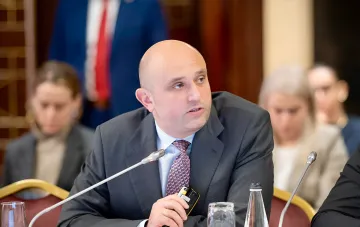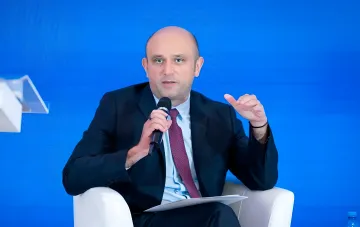
Prime Minister of Ukraine Sergiy Koretsky, speaking at the 12th Kyiv International Economic Forum, stated that the amount of direct damage to the national economy — in terms of the loss of business property — from enemy strikes since the beginning of the current year is estimated at more than $7.7 billion. According to him, more than one million square meters of real estate of various types have currently been destroyed or damaged, and by the end of the year, according to the government's baseline forecast, the total amount of losses could rise to $10 billion.
Scope of assessments and most affected sectors
The Cabinet of Ministers press center clarified that the cited estimates apply exclusively to fixed assets, i.e., company property, and do not take into account indirect losses — in particular, the inability to sell goods and other consequences of asset loss. The head of government noted that the energy sector, metallurgy, logistics, processing enterprises, and retail suffered significant destruction. Separately, Koretsky emphasized that due to ongoing strikes, the export of agricultural products through Black Sea ports has significantly decreased.
Impact on the state budget
Taking into account accumulated losses and ongoing attacks, the government expects that by the end of the year the state budget will fall short of its plans by approximately $1.5 billion. The Prime Minister called this figure the baseline forecast that the agency currently has, and linked it to the direct impact of strikes on the tax base and the operation of enterprises.
Concessional lending for large business
To support businesses affected by shelling and to develop new projects, the government is launching a state concessional lending program for large companies. According to Koretsky, it is planned to issue about 2 billion hryvnias per company into single hands at a preferential interest rate of about 10%, and the state will be able to provide the missing funds for a specific project at already market rates. The 2026 budget provided 18 billion hryvnias to finance concessional lending programs, but, according to the government's assessment, this amount needs to be raised to 22 billion hryvnias. For medium and small businesses, the "5-7-9" program continues to operate, which since its launch has allowed issuing loans to companies for a total amount of about 580 billion hryvnias.
Broader context: recovery estimates and indirect losses
The stated figures fit into larger assessments of the scale of damage. In February 2025, the World Bank and the European Bank for Reconstruction and Development published an estimate of the funds needed to rebuild Ukraine over the next decade — $524 billion, which is 8% higher than the figure of February 2024 ($486 billion). In February 2026, the Kyiv School of Economics estimated the indirect losses of the national economy from the war at $1.7 trillion (loss of current and projected revenue) and $0.6 trillion (loss of added value). Thus, the $7.7–10 billion voiced at the forum reflect only the direct part of the damage for the current year, while the cumulative economic effect of the war is orders of magnitude higher.
Environmental damage and register of losses
In addition to economic damage, the war has caused significant harm to the environment. According to the assessment of Academician Yakym Didukh, head of the Department of Geobotany and Ecology at the M.G. Kholodny Institute of Botany of the National Academy of Sciences of Ukraine, the loss of one hectare of forest as a result of hostilities is estimated at $10,000–$15,000. At the citizen level, Ukrainians can register economic losses from the war in the International Register of Damage: in March 2025, the government expanded the list of registered cases, including damage and loss of non-residential property, as well as the loss of access to non-residential buildings in the temporarily occupied territory.