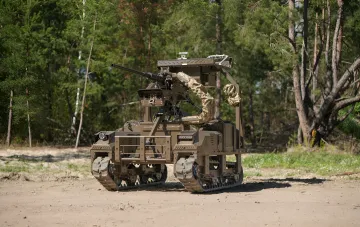
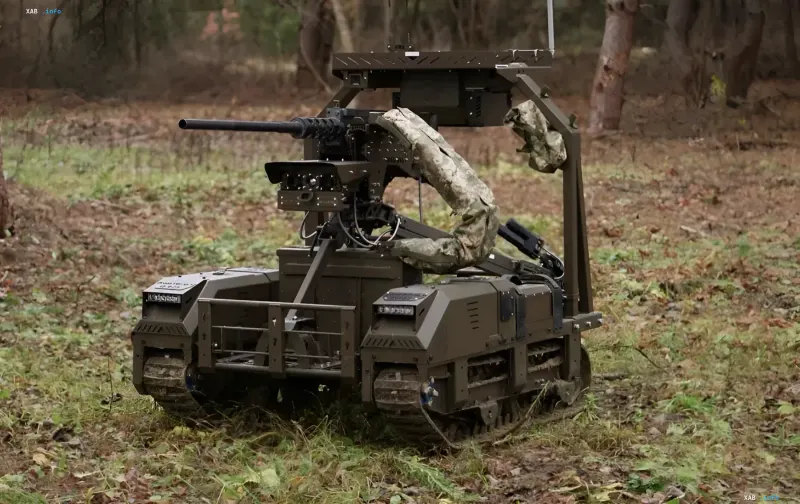
The Ukrainian ground robotic complex Droid TW-12.7, manufactured by DevDroid, survived five FPV drone hits during a combat operation and retained its ability to move and fire, according to the developer's press release. It was only the sixth strike that disabled the machine. This was reported by RBC-Ukraine, citing a DevDroid press release. Soldiers of the fire support company of the 74th Separate Reconnaissance Battalion used the complex in a remote operation to clear an enemy personnel assembly area, allowing the mission to be accomplished without exposing their own personnel to direct contact with the enemy.
Course of the battle: sight damaged, fire directed along the barrel
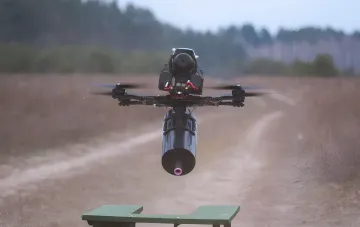
According to the account of the engagement, as the complex approached enemy positions, two FPV drones attacked it almost simultaneously. One of the hits damaged the aiming module, but the robot retained its mobility and continued carrying out the task. Despite the damaged optics, the operators opened fire on the target, aiming along the direction of the barrel. During subsequent operations, the ground robot took two more FPV drone hits but withstood them and completed the combat mission. On the return route, the complex survived a fifth hit and continued moving; only the sixth attack finally disabled the Droid TW-12.7. As a result, the enemy assembly area was cleared, and the enemy suffered losses.
What is the Droid TW-12.7
The Droid TW-12.7 is a comprehensive solution for reconnaissance and fire missions on the battlefield, developed by the DevDroid engineering team. The platform combines remote control, a built-in ballistic computer, and artificial intelligence algorithms, which, according to the developer, enable it to detect, track, and engage targets. The remotely operated turret, fitted with a 12.7 mm M2 Browning machine gun, is designed to engage lightly armored targets — infantry fighting vehicles, armored personnel carriers, armored vehicles — as well as unarmored vehicles and personnel at short and medium ranges, including fire suppression of squad-level units. Built-in cameras and data transmission systems allow the complex to be used for remote battlefield observation, while its design ensures high off-road mobility and minimal deployment time.
The practical meaning of survivability
According to DevDroid CEO Yuri Poritsky, in this battle the enemy was able to stop the robot only with the sixth FPV drone, yet still failed to disrupt the combat mission. He emphasizes that this is precisely the practical significance of survivability: after being hit, the system must not merely remain operational, but retain enough functionality for the operators to bring the mission to a successful result. Thus, the key metric is not the number of hits withstood as such, but the preservation of combat capability in critical subsystems — the drive, control, and fire modules.
Limits of ground robotics
At the same time, the use of ground robotic complexes on the front line has its own limitations. As RBC-Ukraine noted, ground robots cannot fully replace armored vehicles for evacuating wounded soldiers, and reallocating the defense budget toward robotics may complicate the extraction of fighters from the combat zone. This means that robotic platforms are viewed as a supplement to the existing arsenal, not as a universal replacement for armored vehicles.
Contradictory data
All quantitative details of the battle — the number of hits, the sequence of attacks, the nature of the damage — come from the manufacturer DevDroid's press release and are not confirmed by an independent source or public video of this specific episode, so the exact figure of "six hits" currently rests on the developer's self-report. Moreover, public coverage of DevDroid robotics features different modifications of the platform: in some materials (including on tech.liga.net), the combat use of the Droid TW-7.62 variant with a different caliber in a different episode is described. These events should not be conflated with the episode under discussion involving the 12.7 mm TW-12.7 complex, in order to avoid misattributing characteristics and results between modifications.