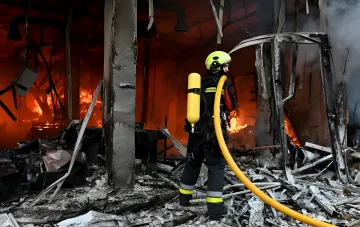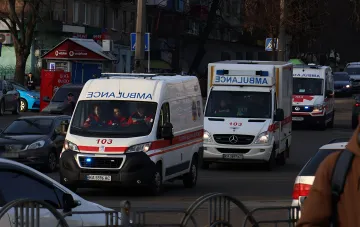
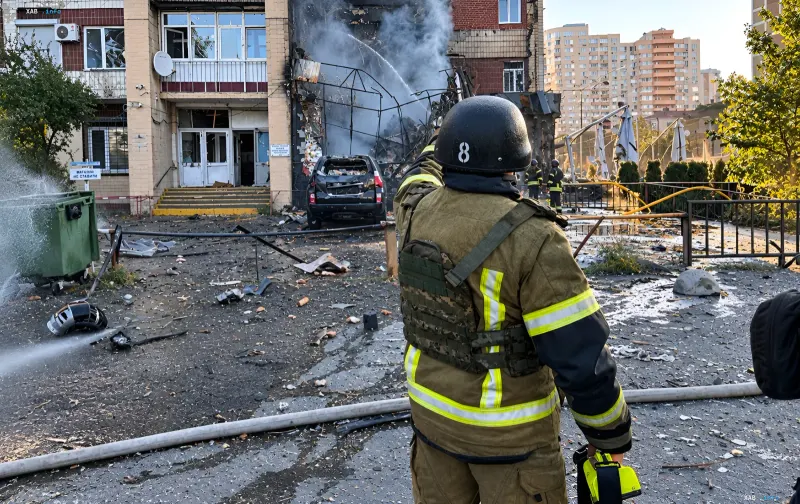
On the morning of September 28, 2026, the capital of Ukraine suffered a massive and cynical attack by hostile jet-powered drones. The air raid alert was accompanied by a series of powerful explosions that rocked various districts of the city, causing panic among the population and large-scale fires at civil infrastructure facilities. According to local authorities and emergency services, the strikes hit not only the outskirts but also the central quarters of the metropolis.
Chronology and Geography of the Morning Strikes
The first impacts were recorded around 6:30 AM local time. In the Obolonskyi district, a strike hit a fuel dispenser at a gas station (petrol station), sparking an immediate fire and the threat of further flames spreading. Later, around 7:27 AM, a similar incident occurred in the Holosiyivskyi district, where a drone struck a cafe located near another gas station. Concurrently, debris from downed UAVs fell onto an open area in the Darnytskyi district, causing localized fires of dry grass and debris.
Damaged Facilities in the City Center and Residential Areas
The situation in the central and northern districts of Kyiv also proved extremely severe. In the Obolonskyi district, a UAV fell onto the territory of non-residential development. The strike on the Shevchenkivskyi district caused the greatest resonance, as a drone damaged the building of the National Academy of Sciences of Ukraine. In the Podilskyi district, falling debris and the blast wave injured three people, including a 15-year-old boy and girl who received aid on the spot, as well as a 17-year-old teenager who was promptly hospitalized by paramedics.
Contradictory Data
Official reports and news from the scene revealed certain discrepancies regarding the overall scale of destruction and the exact number of casualties. Specifically, Oleksandr Sazanovych, the head of the Shevchenkivskyi District State Administration in Kyiv, officially confirmed information about dead and severely injured citizens as a result of the morning attack. At the same time, operational reports from specialized agencies and the State Emergency Service (SES) at the time of publication continue to clarify casualty lists in other districts of the capital, recording varying numbers of hospitalized individuals depending on the severity of their injuries.
Expert Assessment and Political Context
Military analysts and experts attribute the intensification of aerial terror against peaceful Ukrainian cities to a general deadlock on the diplomatic track. In particular, analysts at the American Institute for the Study of War (ISW) previously noted the extremely low likelihood that the military-political leadership of Russia would agree to any energy or humanitarian truces. A new wave of strikes on the capital's infrastructure once again demonstrates disregard for international humanitarian law and the aggressor's focus on intimidating the civilian population.