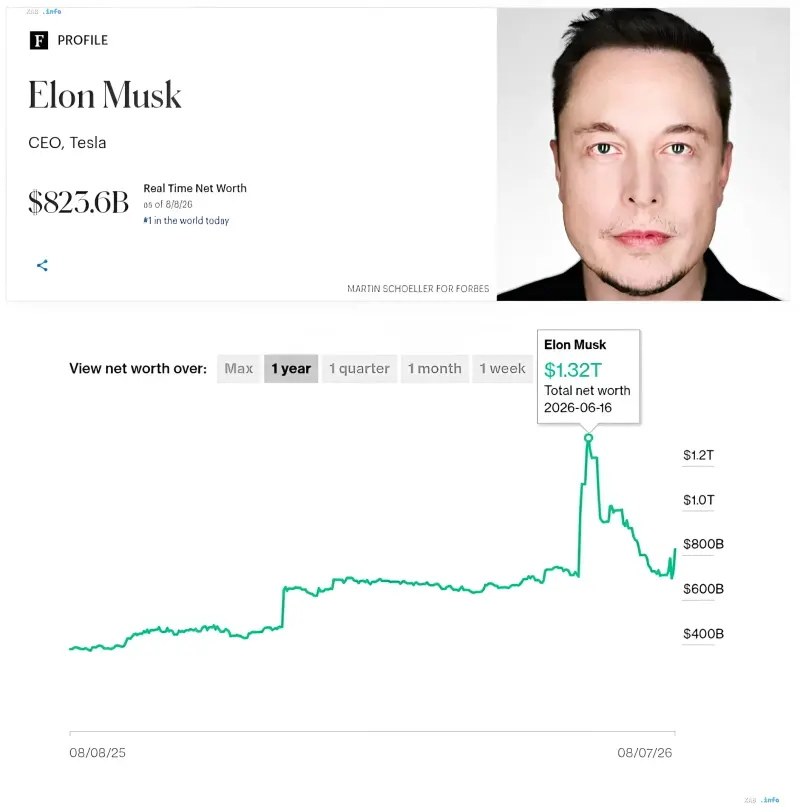
Elon Musk entered history as the first person to cross the trillion-dollar barrier, but this status proved surprisingly ephemeral. Just 12 days after the historic IPO of SpaceX, which marked a new stage in the space race, the entrepreneur's fortune collapsed, returning him to the $900 billion mark. This event became one of the sharpest fluctuations in personal capital in modern financial history.
Historical rise: The birth of the first trillionaire
It all began on June 12, 2026, when the aerospace company SpaceX first went public on the Nasdaq stock exchange. Investor expectations exceeded all forecasts: the company's capitalization instantly exceeded $2 trillion. Since Elon Musk owns a controlling stake (about 38–40%), his personal fortune at that moment jumped to a record $1.1–1.11 trillion. The world saw a new super-rich person, whose name became synonymous with absolute financial dominance.
The peak of euphoria came four days later, on June 16. Against the backdrop of hype, SpaceX shares rose another 40%, pushing Musk's net worth to a historical high of $1.45 trillion. This was the point of no return, from which a rapid rollback began.
Crash and loss of status: Market correction
Exactly 12 days after the IPO, on June 24, 2026, a massive sell-off of tech assets began in global markets. SpaceX shares plummeted by more than 30%, while Tesla shares fell by 6%. On this critical day, Musk's fortune fell below the psychologically important mark — to $957–970 billion. The trillionaire status was lost, and the entrepreneur found himself back in the company of billionaires, although with a huge gap from the rest.
Mathematics of losses: Where did the $513 billion come from?
Financial analysts, summarizing the results on August 9, 2026, made an exact calculation of losses. Comparing the peak point on June 16 ($1.45 trillion) with the minimum point in July ($937 billion), we get a difference of $513 billion. The entire period lasted exactly 53 days. This is a colossal sum, exceeding the GDP of many countries in the world, which disappeared from the virtual accounts of the richest person on the planet.
"Paper" billions: Reality versus figures
It is important to understand a key financial nuance: Elon Musk did not physically lose a single dollar from his bank accounts. All these trillions are the nominal valuation of the shares he owns on the exchange at a specific minute. Since Musk did not sell his securities at the peak, the decline was merely a change in investors' opinion on the value of his companies. This is a classic example of market volatility, where "paper" wealth can evaporate as quickly as it appears.
Current situation: Return to the top
As of today, August 9, 2026, the situation for Musk has improved again. Literally the day before yesterday, on August 7, SpaceX shares bounced back 11.7% after the publication of a strong financial report. According to the Forbes Real Time counter, Musk's capital has returned to the $823.6 billion mark. Despite losing his trillionaire status, he remains by a huge margin the richest person on the planet, demonstrating the resilience of his assets in the face of market storms.