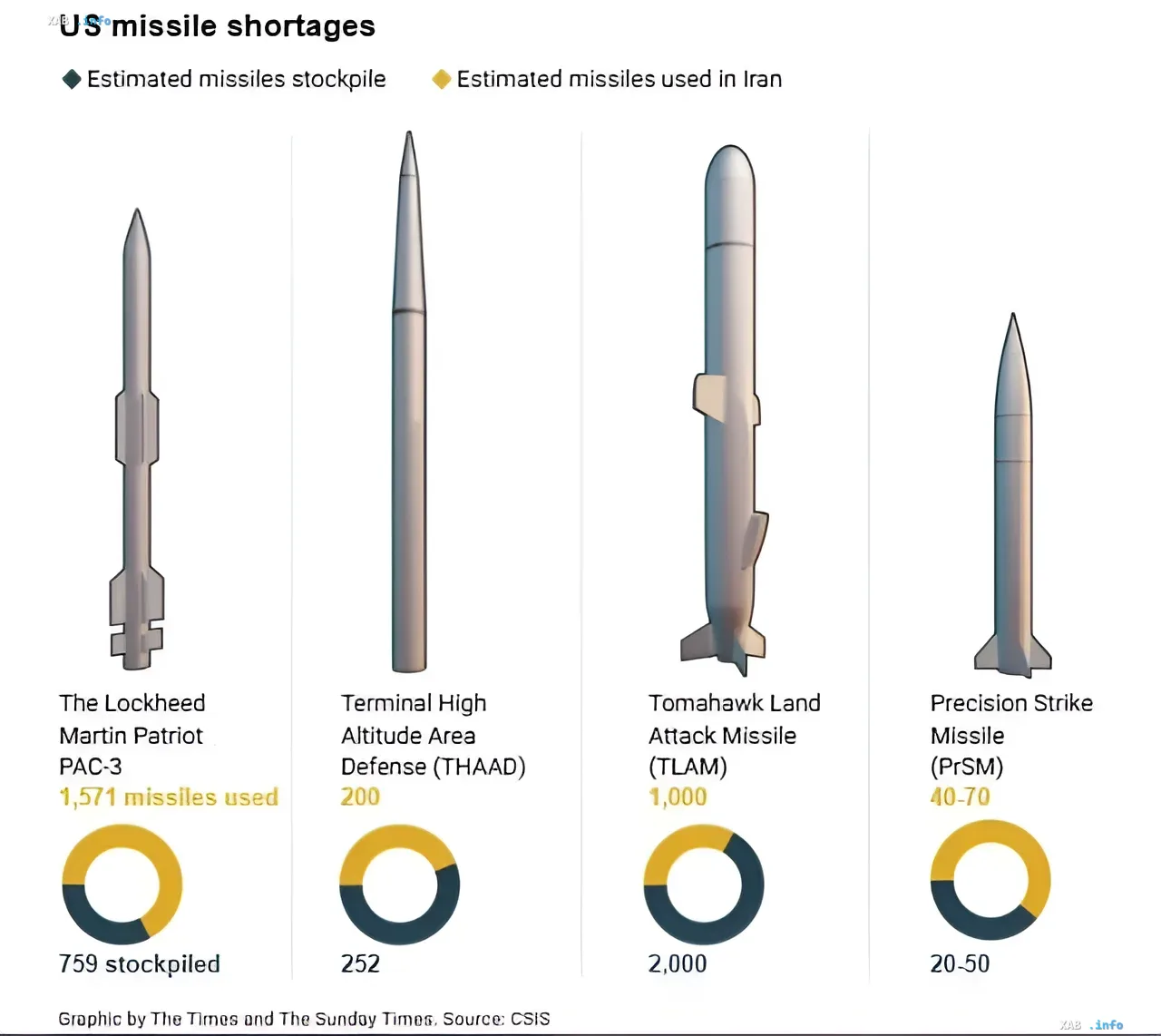
In August 2026, the strategic situation surrounding the United States underwent significant changes. According to authoritative sources, including The New York Times, the American defense industry is facing a critical depletion of precision-guided munitions and air defense systems. This crisis is a direct consequence of the large-scale deployment of military equipment in the ongoing conflict with Iran, which has required the Pentagon to expend resources at volumes not anticipated by standard preparedness scenarios.
Strategic alarm: attention from Beijing and Moscow
The reduction of weapon stockpiles in the US has caused serious concern not only within Washington but also among its geopolitical opponents. Russian and Chinese military specialists are closely analyzing the rate of American ammunition consumption. Experts believe that Moscow and Beijing are using this data to adjust their long-term military plans. If the US demonstrates an inability to quickly replenish arsenals during a prolonged conflict, this may be perceived as a signal of weakness, influencing calculations regarding the probability of new aggression from the West.
The Iranian factor and the production problem
The key factor that depleted the Pentagon's warehouses was the war with Iran. Large-scale operations required a colossal amount of missiles and air defense systems. The problem lies not only in the fact of expenditure but also in the difficulty of replenishing losses. The production of modern high-tech weapon systems is a lengthy and labor-intensive process. Even with emergency increases in funding for the US defense industry, restoring stockpiles to a level sufficient for full-scale warfare could take years. This creates a dangerous gap in the readiness of the US Armed Forces.
The Pacific scenario: a challenge for logistics
Particular concern is raised regarding the US readiness for a potential conflict with China. Experts note that the scale of possible hostilities in the Pacific region will require significantly larger volumes of weaponry than in other theaters of war. The logistical complexities of transporting equipment and ammunition across the ocean, combined with the current shortage of production capacity, create a critical situation. If stockpiles are not replenished in the shortest possible time, the ability of the US to resist in the event of a direct confrontation with the PRC will be in question.
Contradictory data
There is a notable gap between expert assessments and official government statements. On the one hand, independent analysts and media data point to critical depletion of arsenals and the risk of losing strategic superiority. On the other hand, American officials continue to assert that the United States retains the necessary military capabilities and is ready for any challenges. The official Washington stance insists that current measures to accelerate production and replenish arsenals allow for maintaining the balance of power, however, the actual rates of consumption in the conflict with Iran cast doubt on these claims.
Pentagon reaction: acceleration and reform
Aware of the risks, the Pentagon is forced to take decisive measures. The situation with weapon stockpiles has become a catalyst for accelerating production processes and reforming logistical chains. US authorities are attempting to stimulate the defense industry to shorten the production cycle for critical systems. However, despite these efforts, experts warn that restoring full combat readiness is a task that requires time, which may not be available given the current geopolitical tensions.