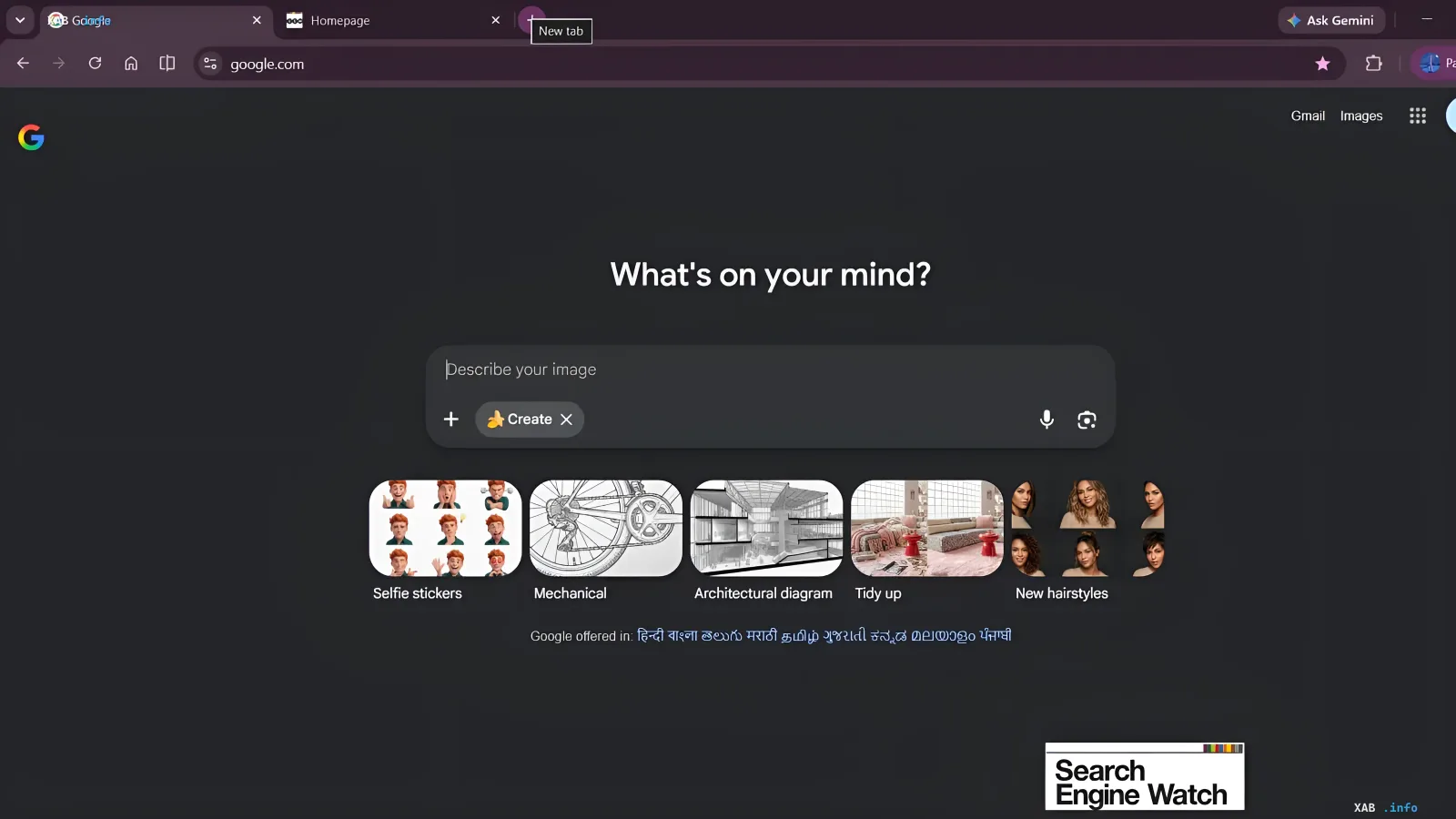
On August 11, 2026, the digital industry is witnessing what many are calling the most radical change in Google's design in the last two decades. The company, whose homepage has remained a benchmark of minimalism and consistency for years, has begun large-scale testing of a new interface version. During the experiment, recorded by independent journalists and users, the famous 'Google Search' button, located to the right of the input field, disappears. It is replaced by three new functional elements focused on generative artificial intelligence.
Interface Transformation: From Search to Generation
According to data obtained from test participants, the traditional search button was replaced by three special shortcuts. These elements do not lead the user to a list of links, but to tools for direct interaction with AI. In particular, among the new features are the ability to upload documents for analysis, initiate a dialogue with the Gemini assistant, and create images. This change radically alters the interaction paradigm: instead of searching for information on the web, the user now receives tools for its instant creation and synthesis right on the start page.
Experiment Conditions: The Role of Authorization
An interesting feature of the current testing is the dependence of functionality on the user's account status. The experiment is being conducted on a small group of unauthorized users (those who have not logged into their Google account). In this mode, document upload and Gemini chat functions are available. However, using image generation tools requires mandatory authorization. Paradoxically, as soon as the user enters their data and logs in, the three new shortcuts disappear, returning the interface to its familiar look. This suggests that Google is testing the new UX specifically as a 'first impression' for new or guest users, trying to immediately engage them in the AI ecosystem.
Strategic Shift: AI Priority Over Links
Search engine experts note that this step marks Google's final transition from the 'search and click' model to the 'query and result' model. If the main goal was previously to show the user relevant links, the company now strives to provide a ready-made answer or generated content before the user even leaves the homepage. This is confirmed by the fact that the testing was recorded in various browsers, indicating a system-level change rather than local bugs or extension experiments.
Contradictory Data
Despite the obviousness of the visual changes, there are discrepancies in the interpretation of the scale of this step. On one hand, sources such as The Next Web and Android Authority confirm the disappearance of the button and the appearance of new shortcuts, calling it an 'AI-first' approach. On the other hand, the lack of an official announcement from Google creates room for speculation. Some observers believe this could be a temporary bug or a very narrow A/B test that will not lead to a global update. Others, citing similar changes in the past, argue that this is the inevitable end of the search engine's evolution, where the 'Search' button will become an archaism, as the search itself now happens inside the AI model rather than through the page index.
Historical Significance of Changes
If the experiment is deemed successful and implemented for a wide audience, it will become one of the most notable changes in interface history. The 'Search' button was a symbol of the internet era, and its removal symbolizes a transition to a new era where information search is replaced by knowledge generation. For Google, this is a risky but necessary step to maintain leadership amidst fierce competition from AI assistants. As analysts note, 2026 may go down in history as the year we stopped 'searching' on Google and started 'talking' to it.