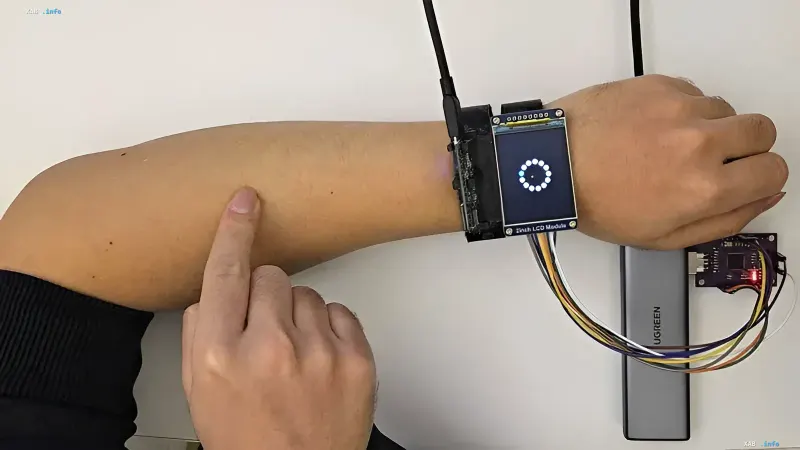
Controlling the small screen of a smartwatch remains one of the most cumbersome tasks in the world of wearable electronics: scrolling, zooming, and multi-finger gestures familiar from smartphones are difficult to perform on a two-inch panel. Researchers from North Carolina State University (USA) have proposed a fundamentally different approach—moving the touch surface from the screen to the user's own skin. Their EpiPad system uses a tiny millimeter-wave radar mounted on the wrist to turn the forearm into a sensitive touch panel capable of recognizing taps, multi-finger movements, and pressure levels.
How the wrist radar works
At the core of EpiPad is a compact millimeter-wave radar, measuring approximately 5 × 4 mm, installed on the user's wrist. Finger touches on the forearm skin cause microscopic deformations of the epidermis, which the radar detects through changes in the phase of the reflected radio signal. It is this phase shift analysis that allows the system to not only determine the fact of a touch and its coordinates but also to estimate the force of the pressure. Recognition of specific gestures—pinching, two-finger scrolling, single taps—is performed using machine learning algorithms trained on data of characteristic skin deformation patterns.
Test results with 20 volunteers
In experiments involving 20 people, gesture recognition accuracy reached 92.8%, and pressure sensitivity detection reached 90.2% accuracy. The accuracy of determining finger position on the forearm surface was 10.2 mm. Before starting, each participant required an individual calibration of the system, which took about four minutes. In a separate comparative experiment, volunteers performed smartwatch control tasks in three ways: directly via the screen, using a cursor controlled by wrist tilt, and via EpiPad. According to the study authors, the EpiPad option ensured the lowest number of errors and the highest task completion efficiency.
From prototype to mass product
The presented prototype takes the form of a bracelet with a protruding electronic board and connecting wires, but according to the study lead Chenhan Xu, the 5 × 4 mm sensor array could well be integrated directly into the housing of regular smartwatches. The cost of the system's functional components in mass production, according to the researchers' calculations, could be less than 10 dollars. This makes the technology potentially accessible for the broad wearables market.
Prospects beyond smartwatches
The researchers point out that EpiPad is not limited to smartwatch control scenarios. The technology is applicable to any device without a full-fledged screen—primarily AI-powered glasses, where the skin of the forearm or wrist could serve as an additional surface for interface control. Thus, EpiPad opens the way to a new class of wearable interfaces where the user's body becomes part of the user input, rather than just a carrier for the gadget.