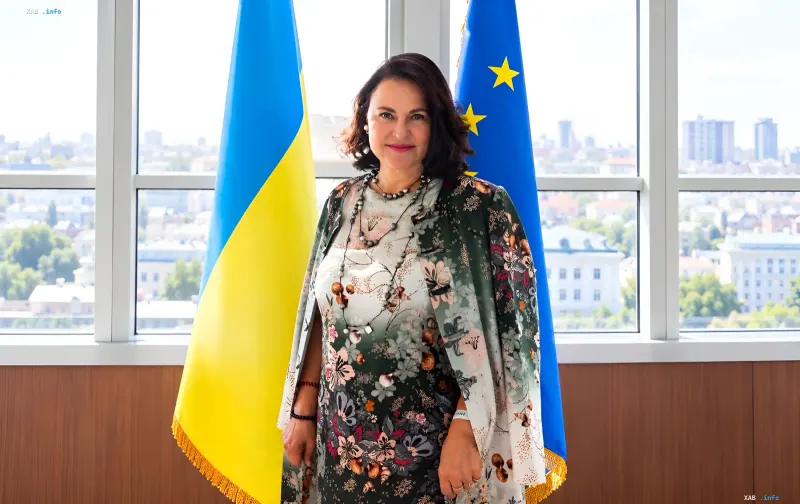
Last week, the European Commission published its annual Enlargement Report, assessing Ukraine’s progress on its path to EU accession. In an exclusive op-ed for RBC-Ukraine, EU Ambassador to Ukraine Katarina Mathernova commented on the document's key findings, explained how Brussels’ two grading scales work, and addressed whether it is appropriate to compare Ukraine's path with Moldova's. According to her, despite the slowdown in a number of reforms, Ukraine has objectively moved forward since the Revolution of Dignity and is closer to European standards than it was a year ago.
Two scales: why “limited progress” does not mean a rollback
Mathernova acknowledges that the European Commission's report format often causes confusion among the Ukrainian audience. One scale evaluates the progress the country has achieved over the past year since the previous report. The second records cumulative progress over several years — meaning how far the country has advanced in a specific area overall. As an example, the Ambassador points to judicial reform: in last year's report, the Commission noted “some level of preparation” and “some progress.” In the current report, the overall level of preparation has been raised by half a point — to an intermediate value between “some” and “moderate.” At the same time, annual progress is assessed as “limited,” as the reform slowed down at the beginning of the year: Ukraine continued to select candidates for vacant judicial positions and vet incumbent judges, yet several legislative changes remain overdue. The conclusion, in the Ambassador's phrasing, is unequivocal: Ukraine's courts are better prepared than a year ago, even though they moved slower over the past twelve months.
Anti-corruption institutions and “Operation Midas”
A separate section of the report is devoted to the work of the National Anti-Corruption Bureau, the Specialized Anti-Corruption Prosecutor's Office, and the High Anti-Corruption Court. The Commission noted that in high-level corruption cases, their activities led to investigations, prosecutions, and final convictions. Mathernova refers to the resonance caused by NABU and SAPO's “Operation Midas” last year and emphasizes: in the midst of a full-scale war, independent investigators were able to investigate allegations reaching the highest echelons of power. “Holding those in power accountable is a difficult test for any democracy. Some EU member states know how hard this can be even in peacetime,” the Ambassador writes. She also points out that Ukraine's readiness depends not only on passing laws, but also on their subsequent implementation: the country has yet to adopt an anti-corruption strategy and carry out a number of other reforms.
July 2025 street protests as an argument for institutions
Mathernova separately highlights the reaction of civil society. In July 2025, after the Verkhovna Rada adopted a law weakening the independence of the anti-corruption bureau and the specialized prosecutor's office, thousands of people — mostly young — took to the streets. According to the Ambassador, parliament subsequently restored key “safeguards.” The current report, she notes, “pays tribute” to those who continue to expose corruption risks and defend the independence of investigators and prosecutors. EU accession, according to the report's wording, is called an effort of the entire society, rather than exclusively governments and agencies.
Why comparison with Moldova is unproductive, according to the Ambassador
The topic of Moldova's progress regularly causes strong emotions in the Ukrainian public sphere. Mathernova acknowledges that Moldova deserves recognition for its reforms and has advanced further in meeting the interim requirements on the rule of law. However, in her estimation, the same membership conditions apply to both countries, while circumstances differ radically: Ukraine is carrying out reforms while simultaneously defending its people and territory from Russia's full-scale invasion, thereby, in the Ambassador's words, helping to protect peace in Europe. “Another round of comparisons with Moldova will do little to help important bills pass through the Verkhovna Rada,” Mathernova summarizes, urging energy to be focused on concrete reforms rather than public discussions about neighbors' paces.
2027 as a “decisive” year and a call for acceleration
Concluding the op-ed, the EU Ambassador addresses the Ukrainian audience, which, as she observes, asks her the same question — when the country will join the Union. Mathernova acknowledges Ukrainians' impatience and states that she wants to see Ukraine part of the “EU family.” At the same time, she warns against pessimism, which she says is often rewarded on social media. On the eve of the “decisive year,” as she calls 2027, the Ambassador urges channeling energy into carrying out the next necessary reforms rather than arguing about how harsh Brussels' wording is. The report, she emphasizes, also contains tough demands — reforms must move faster so that Ukraine has time to use the “historic window of opportunity” for accession.