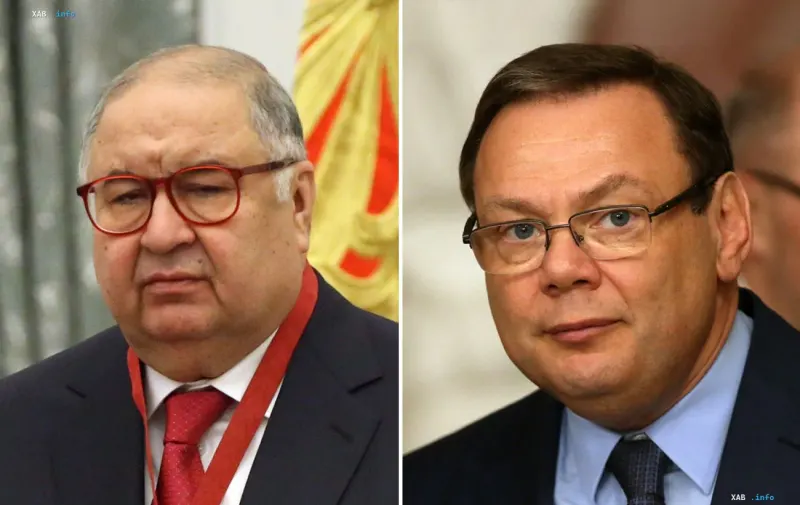
The Committee of Permanent Representatives of the European Union agreed to remove Russian billionaires Alisher Usmanov and Mikhail Fridman from the list of persons subject to the EU's sanctions regime against Russia. The decision was made against the backdrop of the overall extension of the existing restrictive measures against Moscow. According to Ukrainian and European sources, France played a key role in lobbying for the exclusion of the two oligarchs, which provoked a sharp reaction from several member states — in particular, Estonia demanded a public explanation of its position from Paris.
Kyiv Launches the National Sanctions Mechanism
Ukraine's Presidential Commissioner for Sanctions Policy, Vladyslav Vlasyuk, confirmed in an exclusive comment to RBC-Ukraine that Kyiv is already coordinating actions with a number of EU member states on the introduction of national sanctions against Usmanov and Fridman. "We are already working with many EU member states on the introduction of national sanctions against Usmanov and Fridman," he stated. Thus, even if the European-level restrictions in Brussels are lifted, individual countries may retain or introduce their own restrictions against these individuals.
New Packages: Focus on the Military-Industrial Complex
In addition to working on national sanctions, Vlasyuk reported that Ukraine is in negotiations with Brussels on the formation of new sanctions decisions, primarily aimed at Russian oligarchs linked to the military-industrial complex. According to him, the goal is to prevent Kremlin-aligned businessmen from financing the Russian war machine. Head of the Presidential Office Kirill Budanov previously publicly called on the EU not to weaken the sanctions regime, emphasizing that this is not simply about "businessmen who were close to the Kremlin," but about figures whose assets and funding channels directly support the combat operations.
Contradictory Data
The wording of different sources contains a significant difference in describing what happened. A number of Ukrainian media outlets (including RBC-Ukraine) use the phrasing "the EU lifted sanctions on Usmanov and Fridman," which may give the reader the impression of a complete cancellation of the restrictions. However, according to Gordonua data, the EU's Committee of Permanent Representatives decided specifically to exclude the two individuals from the active list while simultaneously extending the remaining sanctions packages against Russia. In other words, the overall regime of restrictions is preserved, and the change concerns only the two specific names. Moreover, regarding France's role: Estonia describes Paris's actions as "insisting on the lifting of sanctions," whereas in European diplomatic channels this may be presented as a "review of the justification of the restrictions" within the framework of the regular review of the list. The difference in emphasis affects the assessment of the scale of what happened.
Intra-European Split and Prospects
Estonia's demand that France explain its position demonstrates that there is no single consensus within the EU on the sanctions policy toward Russian oligarchs. For Ukraine, this creates a dual challenge: on the one hand, it is necessary to achieve the preservation of pressure at the European Union level; on the other hand, to build an alternative mechanism through the national sanctions of individual states. Vlasyuk emphasizes that work is being carried out "with many" countries, indicating the formation of a coalition ready to act outside the framework of a common European decision. In the coming weeks, Kyiv is expected to present Brussels with concrete proposals for new sanctions packages focused on defense oligarchs, which will be a test of the EU's readiness to tighten, rather than weaken, the restrictive regime.