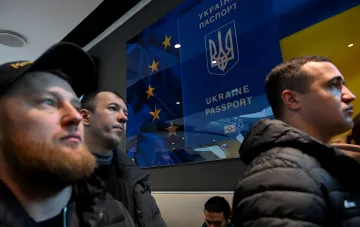
On July 30, 2026, the Council of the European Union adopted Decision 2026/1912, extending the temporary protection mechanism for displaced persons from Ukraine until March 4, 2028. Along with the extension, an additional condition was included in the document, which entered into force on August 5, 2026: temporary protection is now granted to persons who fulfill their military obligations in Ukraine and are able to confirm this if necessary. The innovation does not establish a general ban on obtaining status for all Ukrainian men, but it introduces a procedure for verifying the circumstances of departure from the country for those applying for protection after the requirement comes into force.
Who is practically affected by the changes
First of all, the new rules affect Ukrainians who apply for temporary protection after August 5, 2026, and have military obligations under Ukrainian law. When considering an application, the competent authorities of an EU member state may check whether the applicant had the right to leave the territory of Ukraine taking into account their military status. Importantly, the EU Council decision explicitly states that military obligations may apply not only to persons of conscription age, but also to those who are exempt from conscription, regardless of age or gender, for example, in connection with military service. Thus, the wording «person with military obligations» in the context of the new requirement is broader than the everyday understanding of «military-age man».
What documents may be requested during processing
The European Commission's clarifications provide a list of documents that can be used to confirm legal departure from Ukraine. These include: a foreign passport with a stamp of the Ukrainian border guard service on departure; information confirming border crossing through an official checkpoint; official documents on exemption from military obligations or their fulfillment; electronic documents, including those generated through the «Reserve+» application. The European Commission separately emphasizes that the absence of a stamp in the passport does not always mean the absence of the right to protection: stamps are not affixed in all cases when crossing the border, so the applicant has the right to provide other documents allowing to verify the legality of departure. The final assessment of the submitted materials is carried out by the competent authorities of the specific country where the person is applying for protection.
What happens to already granted protection
For Ukrainians who received temporary protection before the introduction of the new requirements, the EU Council decision provides an exception. The new conditions do not apply to persons who had temporary protection in a specific EU member state as of August 4, 2026, inclusive, and continuously maintain this status in the same country. The mere fact of adopting a new decision is not a ground for the automatic cancellation of protection that is already in effect. However, it is important to distinguish between extending an existing status and new registration: if a person for any reason lost protection and subsequently re-applies, their documents will be checked in accordance with the new requirements. This means that a lost status is not automatically restored and requires going through the full procedure anew.
National implementation features
In Germany, the changes were recorded in the Federal Law Gazette (Bundesgesetzblatt) by a decree introduced by the country's Interior Ministry. German legislation explicitly states that for liable Ukrainian men who entered the country after August 5, 2026, special rules for temporary stay without an ID card no longer apply if there is no documentary confirmation of the fulfillment of military obligations or legal exemption from them. In the Czech Republic, as of October 2026, the government is considering additional restrictions for certain categories of Ukrainian refugees. It is also worth noting Montenegro: on October 15, 2026, the country's government tightened the conditions of temporary protection for Ukrainian men with military obligations, explaining the step as alignment with European Union standards, although formally Montenegro is not an EU member, but a candidate country. In Podgorica, the new status will only be granted to those who actually lived in Ukraine before arrival and fulfilled their military obligation or were exempt from it; those who already have protection are not affected by the changes.
Long trips and the risk of losing status
The European Commission draws attention to the issue of long trips to Ukraine. Under certain circumstances, a prolonged absence from the country that granted temporary protection may lead to deregistration and termination of the residence permit. Specific terms and procedures depend on the national legislation of the respective EU state. If, after losing status, a person wants to apply for temporary protection again, they will have to go through the procedure again, and in this case, new requirements regarding the confirmation of legal departure from Ukraine will apply. Therefore, before a long trip, it is recommended to check the rules for maintaining status in the specific country where it was issued. If the applicant cannot confirm the fulfillment of military obligations or the legality of departure, this may affect the decision on granting protection, but a refusal within the framework of the temporary protection procedure does not mean an automatic deportation decision: European legislation provides for other legal protection mechanisms.