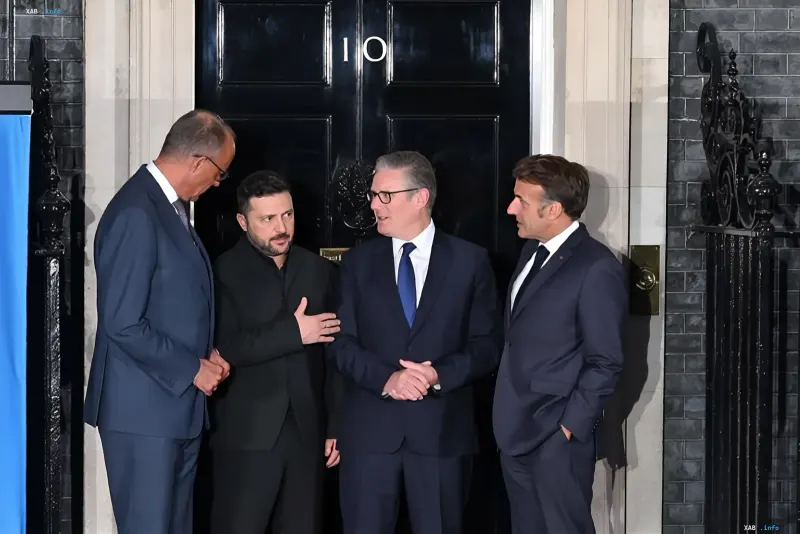
In London, against the backdrop of the famous No. 10 door at Downing Street, a new geopolitical reality took shape in August 2026. European leaders, including French President Emmanuel Macron, German Chancellor Friedrich Merz, and British Prime Minister Kevin Holland, alongside Ukrainian President Volodymyr Zelenskyy, are demonstrating unity, yet intense diplomatic work is underway behind the scenes. Seeking to avoid marginalization in the process of resolving the Ukrainian conflict, France, Germany, and the United Kingdom are developing their own negotiation framework. This step is dictated by fears that the Donald Trump administration might conduct peace agreements with Russia without active European participation, leaving the continent as a mere observer of its own fate.
Strategy 'Europe-3': Attempt to preserve sovereignty in negotiations
According to data obtained from European officials, Paris and Berlin have taken the lead in forming a unified position, while London participates in the process cautiously, weighing its relations with Washington. Diplomats emphasize that resolving the war and defining the future format of relations with the Russian Federation are existential security issues for the Old World. Europe can no longer afford to rely entirely on the United States, a partner whose policy in 2026 is considered increasingly unpredictable. Although European leaders acknowledge that any negotiations with Moscow will take place with US mediation, they are seeking strict guarantees: a peace agreement cannot be signed without a veto or the participation of European delegations.
Crisis of Ukraine's diplomatic representation in the US
Parallel to European diplomacy, Ukraine is facing a serious personnel crisis in Washington. President Volodymyr Zelenskyy is experiencing difficulties in finding a candidate for the post of Ambassador to the US who possesses sufficient authority and experience. Following the dismissal of his predecessor, Olha Stefanishyna, on August 3, 2026, the position remained vacant. Zelenskyy offered this position to Yulia Sviridenko, the former Prime Minister, but she declined the offer. Experts note that potential candidates are wary of taking this post, as they are unsure of the level of trust from the new US administration and do not want to become 'hostages' of a complex political situation.
Military deficit and the critical winter of 2026
The vacant ambassadorial post becomes particularly critical against the backdrop of reduced military aid. President Zelenskyy stated that the number of air defense missiles supplied by allies has decreased by approximately two-thirds compared to 2025. In conditions where Russia has doubled the rate of ballistic missile launches, Ukraine finds itself in a vulnerable position. Zelenskyy pointed to the harsh arithmetic of survival: if Washington sells Kyiv a quantity of missiles equivalent to 5% of its current stockpiles, Ukraine can survive the winter. If this figure reaches 10%, Kyiv can intercept all ballistic missiles. Thus, the future ambassador will be responsible for lobbying in Congress and resolving issues related to the licensing of Patriot missile production.
Internal political turbulence and appointment delays
The search for a new ambassador is complicated by the internal political situation in Kyiv. Recent reshuffles in the government, including the dismissal of Defense Minister Mykhailo Fedorov in July, have sparked protests and criticism. Opposition deputy Yaroslav Yurchyshyn suggested that Zelenskyy might intentionally delay the appointment of a new ambassador until the end of the US midterm elections. This would give Kyiv more time to assess the political situation in Washington and choose a candidate who can work effectively in the new power configuration. However, such a strategy carries risks, as it delays the process of obtaining critically important military support.
Contradictory data
There are discrepancies in assessments of the prospects for Europe's participation in negotiations. On the one hand, European diplomats declare their readiness for an 'autonomous' position and the development of their own scenarios. On the other hand, analysts note that without direct US support, any European initiative could be blocked by Russia, which traditionally views the US as the main negotiation partner. Furthermore, while officials speak of the unity of 'Europe-3', sources in London indicate that the UK may take a more pragmatic stance, leaning towards Washington's demands, creating a risk of a rift in the European coalition.