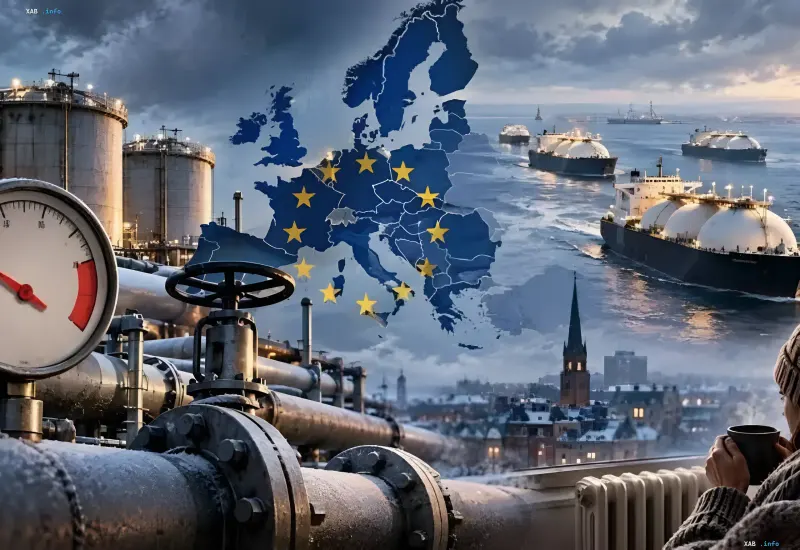
Natural gas prices in the European Union have risen to their highest level in four years, reflecting the deep vulnerability of the region's energy market to external geopolitical shocks. At the main Dutch TTF hub, the cost of front-month futures contracts rose by another 2 percent during trading to reach 86.79 euros per megawatt-hour. This price surge is a logical continuation of months of tension caused by structural changes in supply chains and the abandonment of traditional pipeline supplies from the eastern direction.
Causes of the Energy Crisis and the Situation in the Strait of Hormuz
According to European media citing comprehensive research from major Dutch bank ING, international markets are having to spend most of the upcoming severe winter under conditions of severely restricted liquefied natural gas supplies from the Persian Gulf. One of the main factors shaking Europe's energy market has been the effective paralysis of shipping in the Strait of Hormuz. Having abandoned Russian pipeline gas, the European Union has become critically dependent on LNG from the US and the Middle East. However, due to the ongoing military standoff between the US and Israel and Iran, transportation through this key artery, through which about 20 percent of global LNG exports pass, has practically come to a halt.
Competition with Asia and the Threat of Severe Frosts
The situation is exacerbated by fierce competition for energy resources on the global stage. According to Patria Finance chief economist Dominik Rusinka, Europe is fiercely competing with Asian markets for every available LNG carrier in a desperate attempt to fill its depleted storage facilities at the last minute. Additional alarm is caused by the threat of weather anomalies. Arete Energy investment fund director Martin Pacovsky warns that if prolonged and severe frosts hit industrial countries like Germany and Czechia simultaneously, gas prices could spike by tens of percent again, with high prices remaining the primary tool for balancing demand.
Alarming State of Underground Gas Storage Facilities
Data published by Gas Infrastructure Europe as of October 11 shows a very alarming picture of preparations for the heating season. Across Europe as a whole, underground gas storage facilities are filled to less than 74 percent, while the long-term historical average for this period is around 90 percent. The current level is the lowest in 15 years of observations. A particularly difficult situation has developed in Germany, considered the continent's largest gas consumer, where storage facilities are filled to only 60 percent, while in Czechia this figure stands at about 76 percent.
Expert Forecasts and Scenarios for Spring
Despite serious tension and high risks, specialized economists and analysts assume that the continent will still be able to survive the upcoming winter without a complete freezing of infrastructure and catastrophic consumer disconnections. According to Patria Finance mathematical models, depending on the actual intensity of consumption and weather conditions, between 12 and 39 percent of reserve stocks are expected to remain in European storage facilities by the end of March. Experts agree that even in the worst-case scenario, there will be no physical absolute shortage of gas, and the risk of a repeat of the unprecedented 2021–2022 crisis is assessed as moderately low, although overall market security remains fragile.
Controversial Data
While market reports and bank analysts record maximum price indicators in four years and record-low storage fill levels in 15 years, some government officials and industry associations insist that supply diversification through American LNG and reduced overall industrial consumption create a sufficient safety buffer. Critics of official predictions note that such reassuring statements underestimate the cumulative effect of the simultaneous closure of the Strait of Hormuz and peak Asian demand, which could lead to unplanned reserve depletion as early as mid-January.