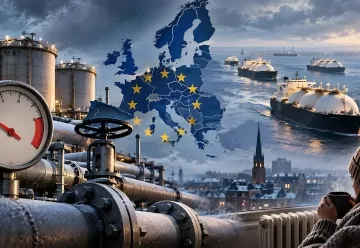
On October 30, 2026, the price of natural gas futures contracts for delivery in January 2027 at Europe's largest gas hub TTF (Netherlands), traded on the ICE International Exchange, reached an absolute historical maximum of €103.9 per megawatt-hour. This is the highest value in the entire trading history of the platform. Converted to Ukrainian realities, this level corresponds to a domestic market gas price of 68.6 hryvnias per cubic meter including VAT. For reference: the €100 per MWh threshold is equivalent to 55 hryvnias per cubic meter excluding VAT and 66 hryvnias with VAT. Thus, the European gas market has not merely returned to high levels — it has surpassed all previous peak values, including the levels of the 2022 energy crisis.
Heating Season, Cold Weather, and Inventory Deficit: The Three Pillars of the Price Surge
ExPro gas market analyst Mykhailo Svyrysho points to a combination of factors that simultaneously pushed quotes above the psychological threshold of €100. First, significant demand is forming in Europe ahead of the 2026–2027 heating season. Second, the filling level of underground gas storage (UGS) facilities in the EU is below 75%, whereas the traditional plan requires at least 80% by November 1. "This year, storage filling is lagging behind Europe's traditional plan; they should have at least 80% by November 1," Svyrysho explains. On certain days in October, gas withdrawal from storage exceeded injection volumes due to abnormal cold snaps, which became the direct trigger for breaking the €100 boundary: quotes were already holding at elevated levels throughout September and October, and the sharp drop in temperatures added urgent demand for the resource.
Middle East, US Elections, and Competition with Asia
An additional driver of growth was the expectation of escalation in the Middle East against the backdrop of the US midterm elections scheduled for November 3. According to Svyrysho, traders are pricing in a scenario of further confrontation between Iran on one side and the US and Israel on the other, and do not expect a quick truce. This maintains a premium on gas as a resource whose supplies could be disrupted. In addition, fierce competition between Asian and European buyers for liquefied natural gas (LNG) persists, further stimulating demand and keeping quotes at elevated levels. EU countries are actively purchasing LNG this season, including from the US and Russia, which increases pressure on the market.
The Norwegian Factor and Ukrainian Export
Another significant factor contributing to exceeding the €100 threshold was the suspension of gas production at one of the fields in Norway, one of the largest natural gas suppliers to the EU. Concurrently, in early October, the Ukrainian government allowed limited export of its own gas. At the October 28 auction, the price of Ukrainian gas reached €90 per MWh. According to Svyrysho's assessment, production companies have already concluded agreements for gas supplies to Europe for future periods at higher prices, although physical deliveries have not yet begun. Some of these volumes will likely be exported in November. At the same time, gas imports to Ukraine are currently present in minimal volumes — about 1 million cubic meters per day, and these supplies are most likely carried out under long-term contracts at prices from previous periods.
Ukrainian Reserves and Import Prospects
Currently, about 16 billion cubic meters of gas have been accumulated in Ukrainian underground storage facilities — more than the initial plan envisaged. Svyrysho believes that these reserves, combined with domestically produced gas, will be sufficient to get through November and December without imports. Purchasing gas from Europe may become relevant in January and February, primarily in a negative scenario where shelling of infrastructure facilities significantly reduces the capacity for production and gas withdrawal from UGS. Today, according to the analyst's assessment, it is unlikely that Ukraine will need to purchase expensive gas as early as November.
What Can Contain the Growth: Scenarios for 2027
As of November 1, 2026, experts estimate that there are no factors that could cause gas prices in Europe to decline. A potential restraining factor could be a truce in the Middle East, opening up LNG supplies from Qatar—one of the world's largest exporters of liquefied gas—however, no such development is expected at present. Qatar ships its LNG exclusively through the Strait of Hormuz, making it vulnerable to geopolitical tensions in the region. In the longer term, LNG supply could be increased by new terminals scheduled for commissioning in 2027 on the US Atlantic coast, which will allow Washington to scale up gas exports, including to the European direction. Of particular note is that starting January 1, 2027, a ban on the purchase of Russian liquefied gas will come into force in the EU. European countries do not plan to abandon this decision, which will additionally stimulate traders to increase purchases of alternative sources and, consequently, maintain demand in the market.