Chinese technology company EUVIC Optics has raised 50 million yuan, approximately 7 million US dollars, to accelerate the development of extreme ultraviolet (EUV) light sources. The primary investor in the current round was the Singapore-based Vertex Ventures fund. The funds will be directed toward refining engineering prototypes and expanding the company's market presence, representing a significant step in the PRC's strategy for achieving technological sovereignty in the semiconductor industry.
Technological Breakthrough in Photolithography
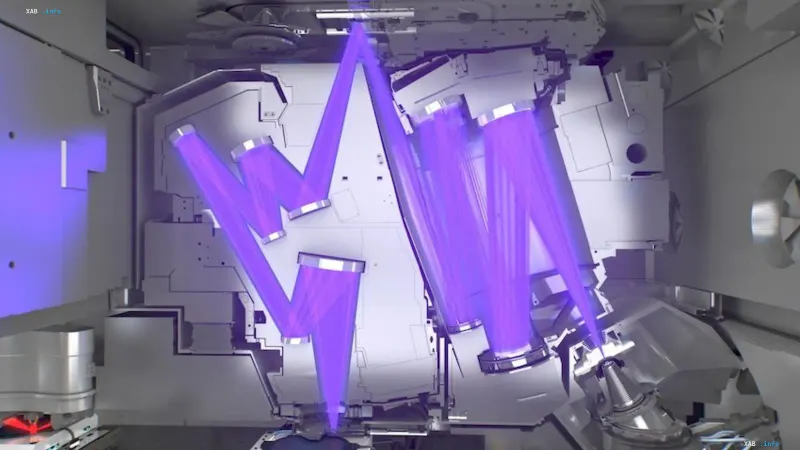
CEO of EUVIC Optics Zhai Tianqi has officially confirmed the creation of China's first engineering prototype of an EUV source based on laser-produced plasma (LPP) technology. This technology is critical for modern lithography as it provides light with a wavelength of 13.5 nm, allowing for the patterning of transistor topologies on silicon wafers with minimal dimensions. The use of LPP sources is an industry standard for creating the most advanced semiconductor products in the world.
Innovative Design Solutions
The company's engineers have implemented several significant changes to the traditional EUV system architecture to enhance reliability and efficiency. Instead of the industry-standard carbon dioxide lasers, EUVIC Optics is focusing on solid-state laser systems. Furthermore, instead of monolithic optical components, the team uses composite mirrors consisting of an array of individual segments. The system for delivering tin droplets, which are converted into plasma by laser radiation, has also been significantly upgraded: the use of wider nozzles is intended to minimize the risk of clogging working components.
Combating Mirror Degradation
One of the primary challenges in building EUV systems remains the contamination of mirrors by byproducts of the plasma reaction, particularly tin vapors. To address this, EUVIC Optics has developed a protection system using an active hydrogen flow and a specialized film based on carbon nanotubes. At the current stage, the company's prototype is not intended for mass-producing chips, but it is already suitable for high-tech research, including chip defect inspection and testing new photoresists.
Prospects for Chip Import Substitution
Developing a domestic foundation for photolithography is China's response to the tightening of external export restrictions. Despite the demonstration of a working prototype, experts note that a significant array of engineering and physical tasks remains to be solved before reaching full-scale commercial operation and creating a complete industrial lithography system. Nevertheless, the success of EUVIC Optics underscores the systematic effort by Chinese developers to overcome barriers in high-end microprocessor manufacturing.