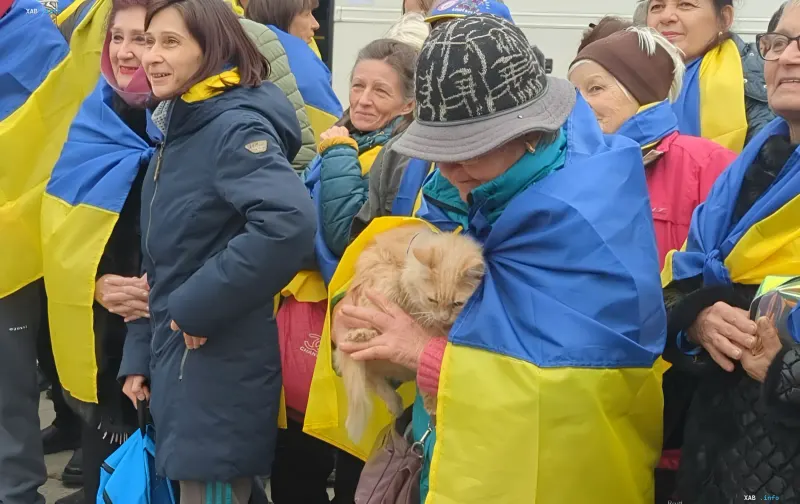
On the afternoon of October 31, evacuated residents from the temporarily Russian-occupied town of Oleshky in the Kherson region arrived on Ukrainian territory in the Chernihiv region on the border with Belarus. A humanitarian convoy operating as part of a special mission evacuated more than 750 people from the city, ranging from a 94-year-old elder to a child just over a year old. The majority of the evacuees headed to Ukraine, while some residents chose to relocate to Russia. On the Ukrainian side, specially prepared tents with hot meals, tea, assistance for children and pets, and a duty medical team were set up for those arriving.
Humanitarian Mission and Ceasefire Regime
On October 27, a ceasefire regime was introduced in the area of temporarily occupied Oleshky to carry out a humanitarian mission implemented with the assistance of US First Lady Melania Trump. The mission involved delivering humanitarian aid to civilians and preparing for the evacuation of local residents. The ceasefire remained in effect until 10:59 PM on November 1. Subsequently, the ceasefire zone was expanded beyond the city limits to ensure the security of the humanitarian convoys. According to the organizers, the ceasefire was not violated during the entire duration of the mission.
Evacuation Convoy and Route of Movement
On October 30, a Ukrainian delegation led by Verkhovna Rada Commissioner for Human Rights Dmytro Lubinets arrived in Oleshky. Ukrainian and American journalists also arrived in the city for independent coverage of the humanitarian mission. The evacuation convoy included 25 buses, 50 medical workers, and ambulances. Immediately upon arrival, evacuation and the distribution of humanitarian aid started in the city. On the evening of October 30, the Ukrainian delegation, along with the evacuated residents, headed to Anapa in Russia, from where they flew by planes to Gomel (Belarus). Afterwards, people crossed the border by buses via the Novaya Huta checkpoint and arrived on the territory of Ukraine.
Border Meeting and Medical Support
On the Ukrainian side, in the Chernihiv region, specially prepared tents were set up for the arrivals. Hot meals, tea, assistance for children and pets were organized inside them. A medical team was on duty, ready to conduct examinations and provide medical assistance if necessary. Andrei Zhidenko, General Director of the Chernihiv Regional Hospital, stated that the evacuees would first be examined by medics and, in the absence of a threat to life, sent to medical institutions or to relatives. Among those greeting them was Irina, who was waiting for her godfather, and Daria, a native of Oleshky herself, who was meeting her father.
Living Conditions in Occupied Oleshky
According to Daria, food problems in Oleshky began immediately after the city was occupied by Russians. By the time of the evacuation, the food situation had become critical: food was not being brought into the city at all. Furthermore, electricity, water, and gas were absent in Oleshky. Daria’s father survived thanks to his own garden, where he grew vegetables, and solar panels that provided electricity, but only in good weather. There was no mobile communication in the city, but sometimes a signal could be caught near a house window, and the father managed to send photos and videos to his relatives.
Animals Evacuated First
The first to be brought to Ukraine were animals rescued from occupied Oleshky. Footage of the arrival shows one of the arriving women, wrapped in a Ukrainian flag, gently holding a ginger cat in her arms. People are rejoicing over their rescue and meeting with relatives on Ukrainian territory. RBC-Ukraine published the first footage of the arrival of the evacuated residents of Oleshky in Ukraine.