A distributed electronic warfare (EW) 'dome' has been operating over Kyiv for more than a year, jamming jet-powered Shahed drones, missiles, and any strike systems that use satellite navigation for targeting. This was stated in an RBC-Ukraine podcast 'TSE BAZA' by Tymofiy Yurkov, co-founder of Contra-Drone. According to him, the system was created even before this year and has been consistently strengthened since then: over twelve months, the number of EW assets around the capital has more than tripled, as Russian drones increase the number of modules in CRPA antennas and require increasingly dense suppression.
How the Dome Works and What It Actually Jams
The mechanics of protection are based on suppressing navigation and radio control channels. While a drone or missile adjusts its trajectory using satellite signals or mesh radio communication with the operator, EW systems introduce an escalating error into this navigation. This is precisely why the dome works well against jet Shaheds, missiles, and any devices dependent on satellite navigation. According to Yurkov's assessment, this is not an isolated installation, but a distributed network of hundreds of points throughout the city; this is also confirmed by presidential advisor on defense technologies Serhii 'Flash' Beskrestnov, who reported the completion of a special operation to deploy equipment across many hundreds of locations involving all major EW manufacturers.
Why the Dome Is Not a Panacea: The Mathematics of Error
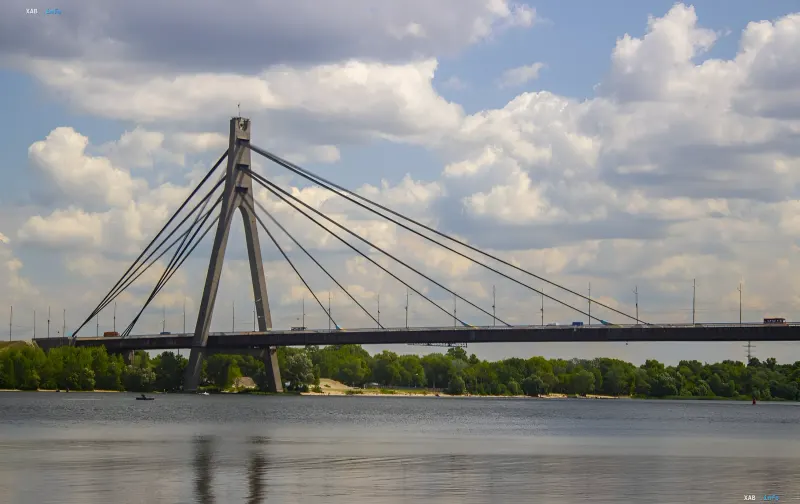
A key limitation pointed out by Yurkov is related to inertial navigation. When a drone is 'jammed' on approach, its internal inertial system continues to guide it by inertia with an error of about 1% — roughly 10 meters per kilometer. If the suppression occurred at a distance of 25 km, the accumulated deviation will be about 250 meters. This means that a drone targeted at a bridge may fall into the water, and one targeted at a substation may hit a residential building. Hence the specialist's main conclusion: the dome protects specific critical facilities, not the entire city, which remains under threat.
What Is Needed for Full Capital Defense
According to Yurkov, for the dome to work as intended, a multi-layered defense must be built around Kyiv and the Kyiv region, 'tracking' Shaheds starting from Russian territory. Then, by the time they enter the city, the guidance error will grow to 2–3 km, and the drone will not reach the target: it will fall in a forest or, in the worst case, in some settlement, but no longer in Kyiv and not into a high-rise building. This approach emphasizes that EW is only one layer of layered defense, not a replacement for the kinetic destruction of the target.
Expert Assessment: A Defense Layer, Not a 'Silver Bullet'
Aviation expert Anatoliy Khrapchynsky previously explained that electronic warfare does not replace the physical shooting down of drones and is one of the elements of multi-level protection. Full security, in his assessment, is provided only by the kinetic destruction of the target outside residential areas. Thus, the EW dome over Kyiv is a significant engineering step forward that reduces but does not eliminate the risk of strikes; its effectiveness directly depends on how deeply and layered the interception system is built on the approach to the capital.