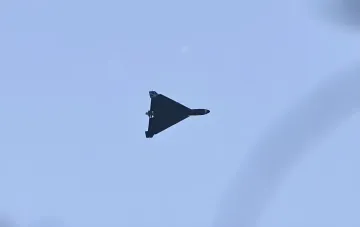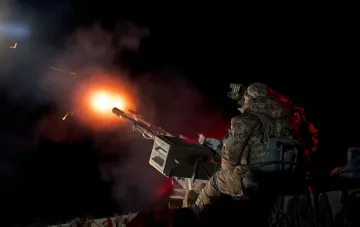
On the night of September 15, 2026, the Russian Armed Forces carried out a massive strike on Ukrainian territory, deploying approximately 200 attack unmanned aerial vehicles. This was reported by the Air Force of the Ukrainian Armed Forces, whose data was relayed by the RBC-Ukraine outlet. The attack began at 18:00 on September 14 and was launched simultaneously from several directions. The aerial offensive included Shahed-type drones, including their jet-powered modifications, Gerbera drones, as well as Parodiya drone decoys designed to overload air defense systems.
Scale of the night attack and air defense operations
Preliminary data received by 08:00 on September 15 indicated that air defense systems shot down or suppressed 187 enemy drones of various types. Meanwhile, as of the morning of September 15, unidentified enemy UAVs remained in Ukrainian airspace, according to the Air Force, indicating that the attack had not yet been fully completed at the time the reports were published. The use of jet-powered Shahed modifications and Parodiya decoys points to an attempt by the Russian side to simultaneously test the limits of Ukraine's air defense and create false targets to expend air-to-air missiles.
Consequences of the strikes: seven locations with hits
Russian aerial attack means reached their targets at seven locations on Ukrainian territory. The fall of debris from shot-down drones was recorded at three additional locations. The exact list of damaged facilities and the number of casualties were not disclosed at the time the preliminary data was published. Nevertheless, the fact of hits at seven points confirms that a significant portion of the attacking drones managed to penetrate the air defense system, despite the overall shoot-down rate exceeding 93% of the stated number of attacking UAVs.
Kyiv under fire: explosions in the Darnytskyi and Obolonskyi districts
In the morning of September 15, drone-related explosions also rocked the capital. According to RBC-Ukraine, an enemy drone hit a gas station in Kyiv's Darnytskyi district. One person was injured as a result of the incident. In addition, a drone struck warehouse facilities in the capital's Obolonskyi district. These incidents continued the night attack and confirmed that strikes on Ukrainian cities, including Kyiv, retain their character as systematic pressure on civilian infrastructure and logistics hubs.
The energy truce: the gap between statements and reality
The context of the night attack takes on particular sharpness against the backdrop of public statements about a possible "energy truce." Earlier, US President Donald Trump stated that Ukraine and Russia had allegedly agreed to cease strikes on energy infrastructure. However, according to the Financial Times, Russian leader Vladimir Putin is not ready to conclude such an agreement before the onset of winter, since, by his calculations, continued strikes on the energy sector should intensify pressure on Kyiv. The night attack of September 15, which involved dozens of jet-powered drones, effectively demonstrates that, in practice, the promises of a truce are not being honored, and the intensity of aerial strikes is not decreasing.
Contradictory data
Discrepancies in the figures are noted between various Air Force reports relayed by Ukrainian media. The primary source (RBC-Ukraine, citing the Ukrainian Armed Forces) indicates an attack by 200 drones and the shoot-down of 187 of them by 08:00. Meanwhile, in another article by the same outlet, titled "Air defense forces shot down more than 300 drones since morning, attack continues," a significantly higher figure is cited — over 300 UAVs shot down. The discrepancy may be explained by the fact that the second report reflects cumulative statistics over a longer period or refers to a different attack date. The exact chronology and the attribution of the figures to specific days are not clarified in open sources, making it impossible to definitively verify the final number of drones shot down during the night of September 14–15.
Thus, the night attack of September 15 confirmed that Russia's aerial offensive against Ukraine retains its massive character and incorporates increasingly complex tactics — from jet-powered Shahed modifications to decoys for overloading air defense. At the same time, the gap between the rhetoric of a "truce" and the actual intensity of the strikes remains a key element of the information confrontation surrounding the conflict.