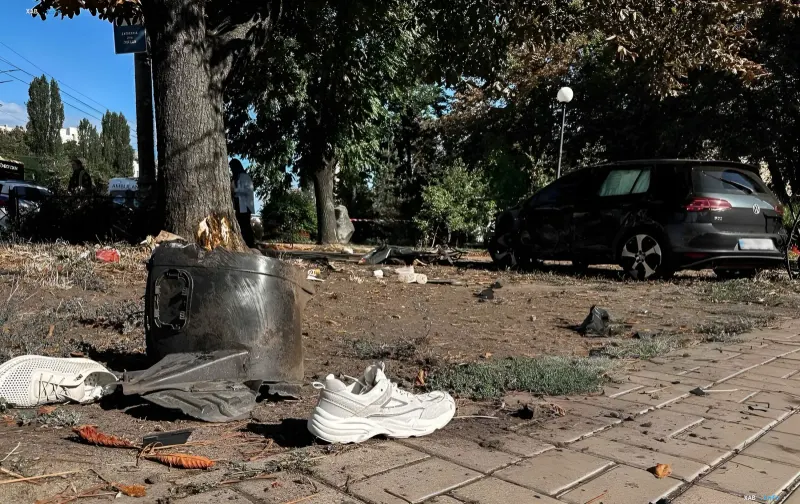
August 19, 2026, Kyiv. A tragic road accident took place in the Solomianskyi district of the capital, claiming two lives. A Volkswagen passenger car, moving at high speed in a dedicated lane, collided with a route bus and crashed into a bus stop where people were present. The investigation established that the driver violated lane-changing rules; however, a key aspect of the investigation became the reaction to the operation of the automatic violation recording system.
Chronology of the tragedy: from the dedicated lane to the bus stop
According to preliminary data obtained from the Patrol Police Department, the incident occurred in the morning hours. The driver of the Volkswagen illegally occupied the lane intended for public transport. Moving at excessive speed, he made a sharp lane change, which led to a head-on collision with a route bus. The impact was so strong that the car did not stop but continued moving, crashing into the bus shelter.
As a result of the accident, two people died on the spot. Another four injured were taken to medical institutions with various injuries. Emergency services, including ambulance teams and rescuers, worked at the scene of the incident, clearing debris and assisting the wounded.
Critical failure: the camera did not record the violation
The Head of the Patrol Police Department, Alexei Beloshitsky, in his statement, drew attention to a paradoxical detail that could be decisive for the investigation. One intersection before the place of the tragedy, at Chokolovskyi Boulevard, 24, there is a camera for automatic recording of traffic rule violations.
"This time it did not record speeding for this car," noted Beloshitsky. This statement casts doubt on the effectiveness of the current control system and raises the question of why the device did not work at the moment when, according to witnesses and the investigation, the car was moving at a dangerous speed. This fact becomes central to the discussion about the reliability of technical safety support on Kyiv's roads.
Contradictory data
Currently, there are discrepancies in the interpretation of data regarding the speed of the car. On the one hand, the patrol police and witnesses testify that the driver was moving at "high speed," which is confirmed by the nature of the damage and the dynamics of the accident (crashing into a bus and a bus stop). On the other hand, the technical data of the automatic recording camera on Chokolovskyi Boulevard does not contain records of speeding by this specific car at the moment of passage.
Experts note that cameras may not record violations at certain shooting angles, weather conditions, or if the speed was exceeded insignificantly at the moment of passing the camera, but increased significantly by the place of collision. However, the lack of recording given such serious consequences raises questions about equipment calibration.
Question of responsibility: fines or license revocation?
The tragedy in the Solomianskyi district has once again raised the acute problem of the adequacy of punishments for dangerous driving. Alexei Beloshitsky emphasized that the current fine system does not fulfill its preventive function. "If the fine for one of the most dangerous violations is actually proportional to the cost of a few liters of fuel, it is difficult to expect that it will have a sufficient preventive effect," stated the head of the police.
In his opinion, responsibility must really restrain drivers. In particular, he proposed introducing a separate level of responsibility for systematic violators — those who receive dozens of orders in a short period and continue to ignore the rules. As a punishment measure, Beloshitsky proposed temporary deprivation of the right to drive, which would allow influencing not a single episode, but the driver's behavior as a whole.