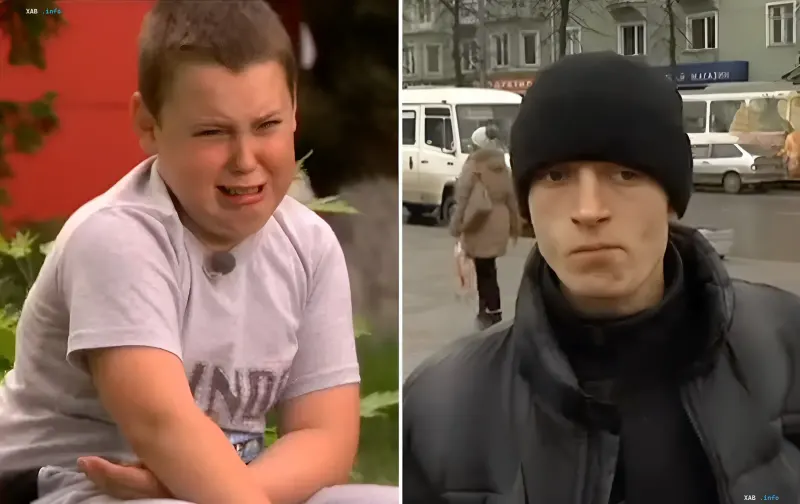
Before the TikTok era, Ukrainian memes were often born entirely by accident: for some, a single emotional street interview was enough; for others, a few seconds on television; and some simply said a phrase that the whole country then started repeating. Their faces and short clips spread through social media faster than news, and their quotes became part of internet culture. The Styler project (RBC-Ukraine) gathered such heroes and found out what happened to them after their wild popularity: some tried to return to a normal life, others ended up back in the news cycle for entirely different reasons, while their old clips continued to live on, separate from the people behind them.
From a street interview to the front: Ivan Martynov
Ivan Martynov from Rivne became famous back in 2014 after a spontaneous street interview. Viewers remembered his emotional manner and the phrase “this is disgusting,” which quickly turned the man into a hero of the Ukrainian internet. But his story did not end there: after the start of the full-scale invasion, Martynov fought as part of the Ukrainian Armed Forces — in the 68th Separate Ranger Brigade he served as a senior gunner and medic. Thus, the man whom Ukrainians knew above all from a meme video later became a serving soldier. According to Styler, in 2023 it became known that Martynov had also gotten married.
“I don’t care if it burns”: the path of Vitaliy Chepурko
Vitaliy Chepurko became famous after a video of his detention, in which he calmly described the arsons. It was his manner of speaking and his phrases about how he “doesn’t care if it burns” that made the clip go viral. Years later, Chepurko reappeared in the news for a different reason: in January 2026 it was reported that he had been mobilized into the Ukrainian Armed Forces and was undergoing training. However, this story has no simple ending — in May 2026 it became known that the soldier had been detained after leaving his unit without permission, and according to Ukrainian media, he was also accused of public threats and calls to violence. Meme popularity, it turned out, does not mean that a person’s subsequent life will be as easy and predictable as in a few-minute video.
“I want a chocolate bar”: Isaac Velichko
Isaac Velichko became famous as a child after taking part in the TV show “Kokhana, my vbyvayemo diyet” (Beloved, we are killing children). That is where his emotional line about the chocolate bar comes from, which became one of the most famous Ukrainian memes. But Velichko did not remain “the boy from the meme”: in 2016 he appeared on “MasterChef Diti” (MasterChef Kids), and later he worked in robotics and studied at Cherkasy National University. In 2025, another high-profile story emerged around him, connected to the spread of inaccurate information about his fate at the front, which Ukrainian media debunked.
Contradictory data
Around Isaac Velichko in 2025 a situation arose with directly opposite versions. On the one hand, Russian resources spread information about the alleged death of Velichko at the front. On the other hand, Ukrainian media debunked this information, confirming that the man is alive and that his further life is not connected with combat operations. Thus, two incompatible versions coexisted in the public space, and fact-checking by Ukrainian publications became the basis for treating the death version as unreliable. This case clearly shows how a person’s meme image can be used in information manipulations detached from reality.
Officials who became part of meme culture: Klitschko and Kim
In the roundup, a special place is occupied by those who were never the hero of a single accidental video. The phrases of Kyiv mayor Vitaliy Klitschko about hot water, “tomorrow,” and other city problems became so firmly embedded in the Ukrainian mood that many perceive them as a genre of their own; meanwhile, Klitschko continues to work as the capital’s mayor, and his old quotes from time to time return to social media in the form of ready-made meme templates. Unlike many accidental heroes of viral clips, he has in fact become part of Ukrainian meme culture himself. A similar story belongs to an official from Mykolaiv, who until February 24, 2022 was known mainly in Mykolaiv and the region: after the start of the full-scale invasion, his daily addresses made him one of the most famous Ukrainian officials. He began his video address with the words “Good evening, we are from Ukraine!”, explaining that he had taken this phrase from a song, and in the first days of the war it was simply used as a greeting by soldiers, law enforcement officers, and residents of the region. The phrase turned into one of the symbols of Ukrainian resistance, and it was popularized by the same-named track by PROBASS ∆ HARDI, released a few years ago. Thanks to his calm manner of speaking in the most difficult moments, he gained a reputation online as a kind of “soothing man,” whose videos were awaited, quoted, and turned into memes. It is worth remembering that in the same vein, teacher Olha Khodos from Volchansk also entered the public space, dedicating her performance on the show “Ukraina maye talant” (Ukraine Has Talent) to her destroyed city.