A New Era of Universal Robotic Intelligence
On August 13, 2026, Feagine Robotics took a step that could revolutionize the paradigm of robotics development. At the presentation, they introduced Fi0 (Foundation Intelligence Across Embodiments) — a foundational artificial intelligence model designed for robot control. The key feature of Fi0 is its ability to transfer task knowledge between different hardware configurations. This means that skills acquired by one robot can be adapted to the morphology and current state of a completely different device, a process that previously required complete reconfiguration or training from scratch.
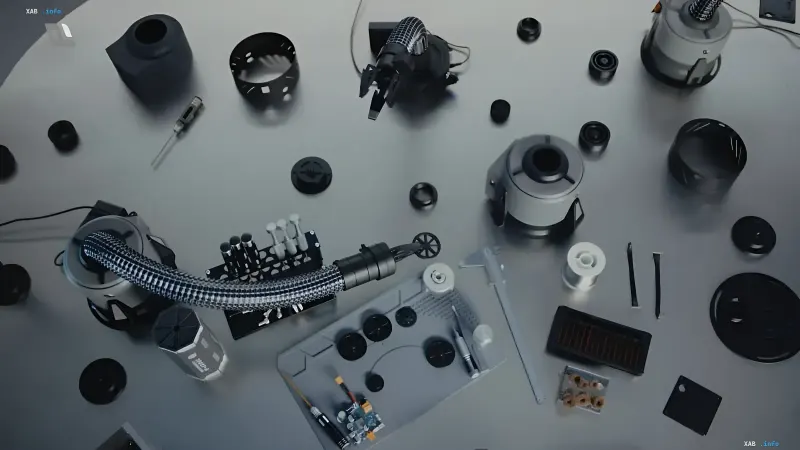
Simultaneously with the model announcement, Feagine demonstrated three prototypes of tendon-driven soft manipulators — A01, A02, and A03. These devices differ in length, number of segments, workspace, and the nature of contact with objects. It is on these three platforms that the company plans to prove the universality of its architecture, separating knowledge about the task itself from the specifics of a particular mechanism.
Fi0 Architecture: From Language to Physical Actions
The operation of Fi0 is based on a multimodal approach to data processing. As input parameters, the model uses natural language, visual data (images), human action demonstrations, the current state of the environment, and a structured description of the robot itself. In the technical description, Feagine claims separate system components responsible for skill representation, fusing images from different cameras, describing the specific robot "embodiment," and predicting the outcomes of planned actions.
According to the developers, the model accounts for the robot's kinematics, geometry, sensors, end-effectors, actuators, and dynamic state. This allows for the use of human demonstrations directly during the execution of a new task without the need to fine-tune the model parameters. This approach theoretically eliminates the need to create unique control algorithms for every new robot model.
Contradictory Data and Lack of Verification
Despite ambitious claims, information about Fi0 currently remains in the status of "confirmed with reservations." Feagine has not disclosed critically important technical details: the volume and composition of the training dataset, the number of model parameters, architecture implementation details, and the methodology for evaluating effectiveness. Without this data, the claimed capabilities cannot yet be compared with reproducible results.
There is a significant gap between the claimed architecture and the proven ability to transfer skills. Feagine has not published success rates for performing the same tasks on manipulators A01, A02, and A03. There is no comparison with separate control models for each robot, nor data on latency, error recovery, or safety. Furthermore, there is no information on the availability of Fi0 for third-party developers, making independent verification impossible.
Prospects and Challenges for Embodied AI
The launch of Fi0 is interesting primarily as an attempt to solve one of the central problems of Embodied AI (artificial intelligence with physical embodiment) — the problem of knowledge transfer. Traditionally, every new robot configuration required training from scratch, which slowed down industry development. Fi0 offers a path to creating a universal "brain" capable of adapting to different "bodies".
However, for a practical assessment of the scale of the claimed breakthrough, reproducible tests, an open experimental methodology, and an honest comparison with baseline systems are now necessary. For now, Fi0 remains a powerful concept, the potential of which will only be understood after the publication of detailed reports on testing on real physical platforms.