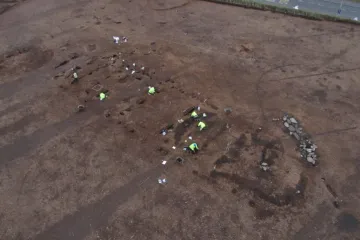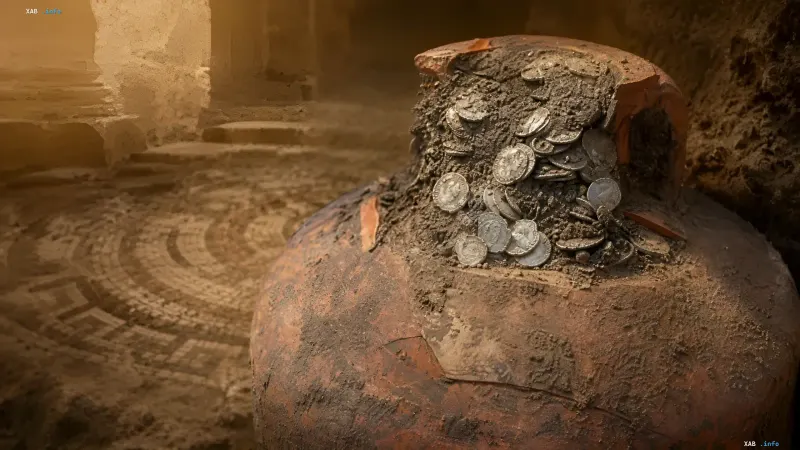
On an ordinary arable field near the German town of Wesseling, one of the most prominent and unique archaeological discoveries in the region's modern history has been made. A local resident, Oliver Riedl, using a metal detector, discovered a total of 934 ancient Roman silver denarii with a combined weight of an impressive 3.1 kilograms. This discovery immediately captured the attention of leading European researchers and specialized government agencies.
Excavation Details and Laboratory Research
Authoritative local media and the Office for the Protection of Archaeological Heritage of the Rhineland Regional Association (LVR-ABR) report on this large-scale discovery. Due to regular agricultural work in the field, the original clay vessel containing the hoard was damaged, and the coins were partially scattered. To prevent the loss of valuable artifacts, specialists extracted the remaining part of the hoard along with a massive block of earth and thoroughly examined it using X-ray imaging in the specialized restoration workshop of the Rheinisches Landesmuseum in Bonn.
Secrets of the Ancient Cache and the Era of Hadrian
Laboratory analyses revealed fragments of a clay jug and remnants of straw, which convincingly confirms that these denarii were carefully hidden inside a straw-lined vessel. According to expert archaeologists, the latest coin in the discovered complex dates back to 124–125 AD, during the reign of Roman Emperor Hadrian. Most of the currency was minted during the Flavian dynasty (69–96 AD).
Historical Significance and Global Scale
This find was officially recognized as the largest hoard of coins from the Hadrianic era in Germany's history and entered the top 5 similar discoveries globally. In ancient times, 934 silver denarii constituted a colossal fortune, comparable to a legionary's salary for several years. Historians suggest that a wealthy Roman or merchant, facing military threats at the empire's northern frontier — the limes near the banks of the Rhine — may have hidden this wealth.
Contradictory Data
While official reports from the LVR-ABR and specialized museums clearly record the total number of coins at 934 pieces and date the final issue to 124–125 AD, initial reports in some regional telegram channels and blogs varied in numbers. Unofficial sources initially claimed the discovery of gold solidi or that the hoard numbered over a thousand items. However, meticulous X-ray imaging of the earth block in Bonn completely disproved these rumors, establishing the exact and immutable number of denarii at 934 pieces with a total weight of 3.1 kg.