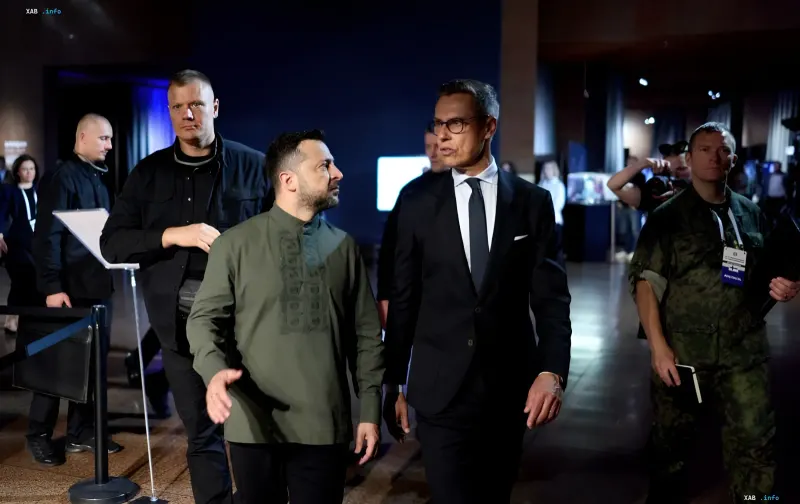
Finnish President Alexander Stubb stated that Helsinki is in the final stage of concluding an agreement on the joint production of unmanned systems with Ukraine. According to him, the deal involves a “90/10 ratio”: the overwhelming majority of the drones produced — around 90% — will be supplied to the Armed Forces of Ukraine, while the remaining 10% will stay in the hands of the Finnish side. The statement was made during the “Ukraine – Nordic-Baltic Eight” summit in Kyiv, where, in the Finnish leader’s assessment, the arrangements have already been effectively formed and only a few minor amendments remain to be made.
The 90/10 Scheme and the “Danish Model” of Cooperation
Stubb clarified that Finnish and Ukrainian companies are already reaching de facto agreements on launching joint production facilities, and that the structure of the cooperation will be built on a fragmented, decentralized scheme, which he compared to the Danish model. “One of the companies has already named a figure for the number of drones that can be produced in Finland, and I think the agreement will be roughly what is called a 90/10 ratio. So 90% of the output goes to Ukraine, and 10% remains in Finland,” the president explained. He emphasized that the partnership would be mutually beneficial for both countries.
A Shift in the Paradigm of Support for Kyiv
Speaking at the summit, Stubb called on European and American partners to reconsider their perception of military and technological aid to Ukraine. In his view, many in Europe and the US “need to get rid of the opinion that we are doing some kind of charity for Ukraine,” because while that may have been true at the start, now “we can learn more from Ukraine than Ukraine learns from us.” In this way, the Finnish leader is effectively redefining the nature of the cooperation — from one-sided support to bilateral technological exchange.
Broader: Joint Production and the Diplomatic Track
The arrangements on joint production go far beyond drones. As Ukrainian media remind, Kyiv and Helsinki have agreed on the development and manufacture of unmanned vehicles for the needs of the Ukrainian Armed Forces and Europe, on the development of maritime unmanned systems, and on the creation of a joint venture for the production of ground robotic complexes. To implement these plans, top managers from seven leading Finnish companies have already arrived in Kyiv. In parallel, Ukraine continues its diplomatic work toward ending the war: according to Kyiv, together with international partners, three key proposals for ending Russian aggression have been worked out and coordinated with the American and European sides.
Context: Doubts About the Rerouting of Drones
Against the backdrop of the discussion on joint production, Stubb had earlier publicly expressed doubt about Russia’s ability to reroute Ukrainian Armed Forces drones toward Finland, which points to the Finnish side’s assessment of the real risks posed by unmanned systems. This context reinforces the pragmatic nature of the Helsinki arrangements: joint production is positioned not only as support for Kyiv, but also as an element of Finland’s own defense and technological strategy.