The strike on industrial facilities in Nizhnekamsk (Tatarstan) on August 20, 2026, marks a qualitative transformation in the capabilities of long-range unmanned aviation. Covering a distance of 1,200–1,400 kilometers over territory saturated with air defense and electronic warfare systems requires not just fuel reserves but a complex navigation architecture capable of operating under conditions of dense satellite signal jamming. According to the specialized resource Militarnyi, the backbone of the long-range fleet consists of FP-1 family aircraft from Fire Point.
Tactical and technical profile of the FP-1 UAV
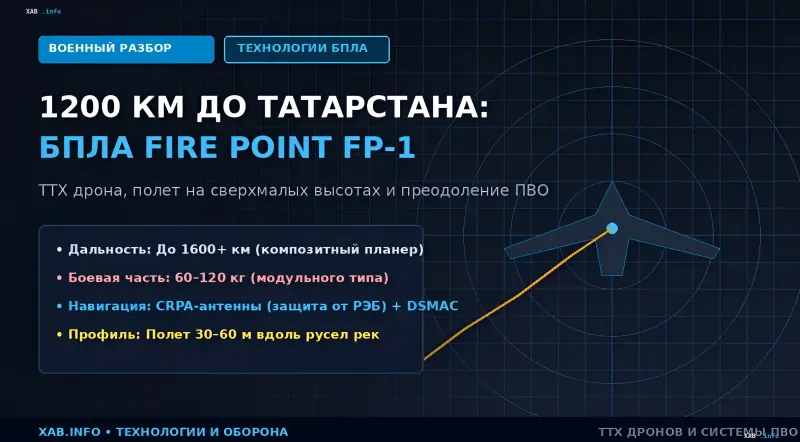
According to published specifications, the range of FP-1 modifications reaches 1,600 km, and in versions with increased integrated fuel tanks—up to 2,000 km. The warhead is modular, weighing from 60 to 120 kg, of high-explosive fragmentation or cumulative-incendiary type, optimized for striking storage tanks and technological columns of oil refining. The power plant is an economical two-stroke piston engine with a pusher propeller, providing a cruising speed of about 140–180 km/h. The airframe is made of composite radio-transparent materials and carbon fiber, which reduces the effective scattering area to minimum values and makes radar detection at low altitudes difficult.
Navigation under conditions of dense electronic warfare suppression
The key technical challenge of deep raids is overcoming the zones of action of EW stations («Polie-21», «Krasukha-4», «Serp»). On FP-1 series aircraft, according to available data, CRPA antennas (anti-jamming phased arrays) are used, suppressing side jamming of GPS/GLONASS spoofing, as well as an inertial navigation system with optical correction (DSMAC), which allows matching terrain and landmarks to a digital elevation map without constant radio communication. The route is plotted along riverbeds (Volga, Kama, Vyatka) and forest areas at an altitude of 30–60 meters, which takes the aircraft beyond the radio horizon of stationary radar stations and minimizes the warning time for ground-based weapons.
Facility protection of industrial giants: systemic air defense gaps
The «TANECO» complex and the neighboring «TAIF-NK» occupy hundreds of hectares, and fully covering such a perimeter requires significant resources. Tensioned wire and metal anti-drone nets around primary processing columns protect against light FPV aircraft, but are penetrated by heavy 100-kilogram warheads of long-range drones. Mobile firing groups with heavy machine guns, thermal imagers, and ZU-23-2 anti-aircraft guns are effective only with timely detection, whereas at extremely low altitudes, acoustic contact occurs seconds before the approach. A shortage of «Pantsir-S1» and «Tor-M2» air defense missile systems, which primarily cover critical airfields and strategic objects in the capital, creates structural gaps in the protection of remote industrial hubs.
Macroeconomic and legal consequences
The strike on one of the largest oil refineries in Russia in Tatarstan and a key energy node in Crimea (according to UNIAN) has significance beyond a tactical incident. Damage to primary processing capacities directly affects the internal balance of petroleum products, fuel logistics, and export potential, increasing pressure on pricing and regulatory mechanisms in the energy sector. From a legal point of view, such raids deep into the territory of a sovereign state are classified as acts of armed aggression and terrorist activities, which form the basis for international legal claims and potential retaliatory measures, as well as increasing requirements for insurance and security regimes for critical industrial infrastructure.
Contradictory data
It is necessary to note that the detailed tactical and technical characteristics of the FP-1 UAV and the exact range of the specific raid of 1,200–1,400 km are not confirmed by independent verified data in open sources and rely primarily on information from the specialized resource Militarnyi. Official statements by the parties are limited to confirming the fact of the strike on facilities in Tatarstan and Crimea; specific models of aircraft, their modifications, and flight parameters have not been publicly disclosed. Thus, the stated passport range of the aircraft (up to 1,600–2,000 km) and the actual raid distance are consistent, however, their exact values remain a matter of assessment rather than independent confirmation.
Long-term consequences for energy security
The systemic conclusion from the events of August 20, 2026, is that the traditional model of perimeter air defense, calculated for ballistics and the radar horizon, proves insufficient to protect distributed industrial facilities from low-flying long-range UAVs. This requires a revision of the facility protection architecture: integration of mobile EW and small-target radar means, development of multi-level anti-aircraft artillery and missile echelons, as well as diversification and reservation of critical energy capacities. In the medium term, such strikes increase the cost of infrastructure protection and redistribute risks in the energy sector, forming a new factor of long-term economic and strategic instability.