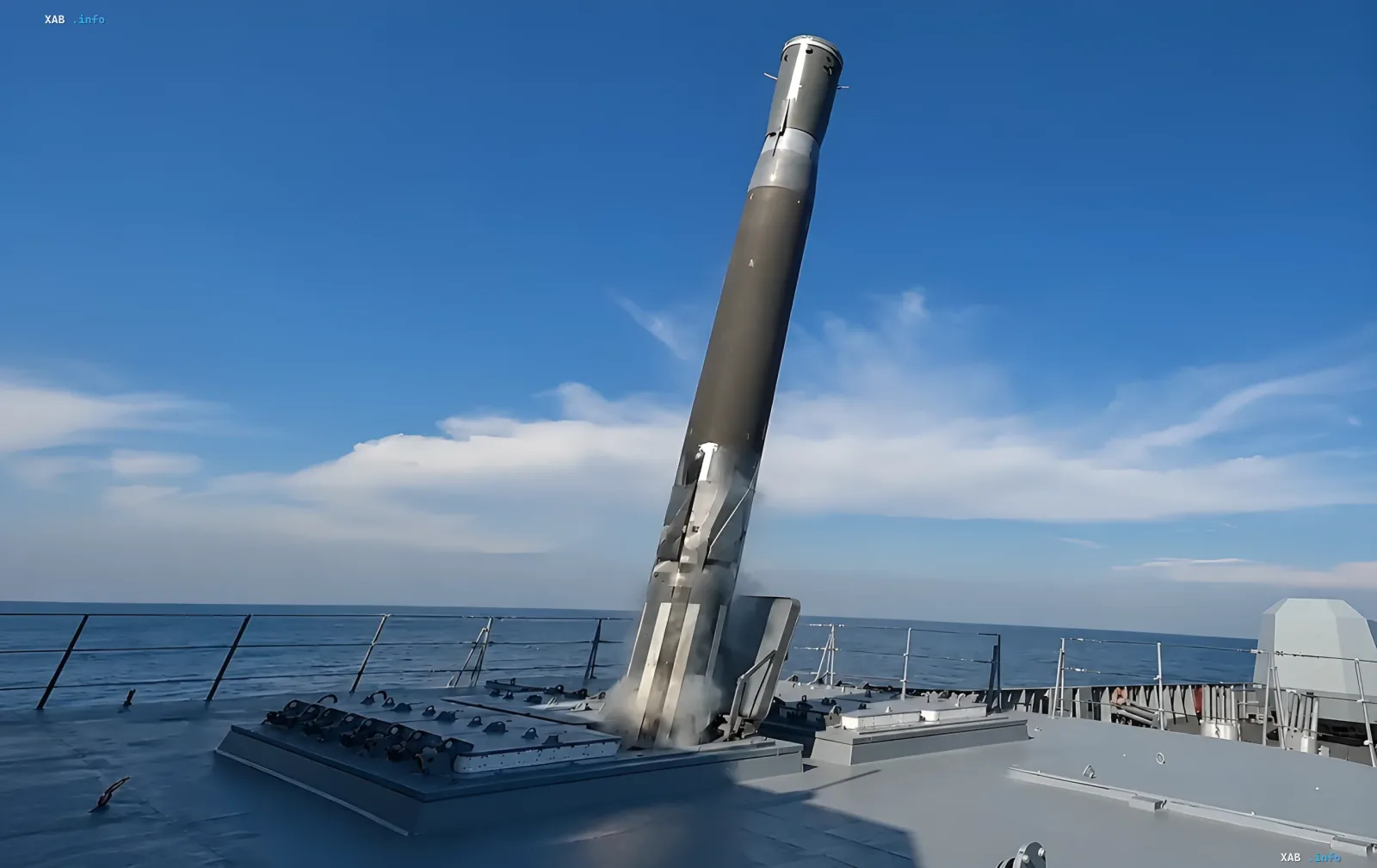
Ukraine's General Staff of the Armed Forces, through the Main Intelligence Directorate (GUR), published a detailed technical breakdown of the 3M22 ballistic missile of the 'Zircon' system — the most expensive strike weapon in the Russian Federation's arsenal. According to intelligence data, not only the missile's design features have been disclosed, but also the facilities involved in its production and the foreign equipment they use. The publication, first reported by RBC-Ukraine, coincides with Russia's active use of new ballistic systems against Ukrainian cities and a growing shortage of air defense assets on the eve of the autumn–winter period.
Shipborne Weapon Adapted for Shore Use
According to GUR data, the 'M' index in the 3M22 designation indicates the missile's original purpose — a ship-targeting weapon. The system was developed for nuclear submarines and Project 22350 frigates equipped with the 3S14 universal complex weapon system (UKSK). However, during the Russian–Ukrainian war, facing serious limitations in the use of its fleet in the Black Sea, Russia was forced to adapt the 3M22 missiles for launch from the 'Bastion-M' shore-based missile complexes. In the assessment of Ukrainian analysts, this decision indicates that the maritime component of Russia's strategic offensive has in fact not been realized, and the expensive weapon is being reprofiled for land-based launchers.
Warhead and Aerodynamics: Titanium Tail and Small Charge
One of the most telling facts disclosed by the GUR is the weight of the 3M22 warhead — around 120 kg. For a missile that the Kremlin positions as the country's most expensive strike weapon, this is an extremely modest figure. For comparison: the short-range cruise missile 'Bandirol' carries a 150 kg warhead, meaning it outperforms the 'Zircon' in destructive potential at a substantially lower cost. The missile's tail section houses electrohydraulic control actuators and aerodynamic control surfaces, which serve as the primary control surfaces. In the transport position the control surfaces are folded, and after exiting the container they deploy. The entire tail section of the missile is made of titanium — a material that provides strength under supersonic loads but significantly increases the cost of the product.
Propulsion and Guidance System
After the missile exits the ship's container or the shore-based 'Bastion-M' complex, a solid-fuel booster engine is ignited, which lifts the weapon to the required altitude and speed. After it separates, the main solid-fuel cruise engine engages. The initial alignment of the missile onto the aiming point's course is handled by the orientation and stabilization system engines, located on the protective fairing, which is subsequently jettisoned. The guidance system is combined: during the cruise phase of flight the missile is guided by an inertial navigation system, while in the final stage it activates an active radar homing seeker. The onboard digital computing complex 'Baget-83', installed on the missile, is typical of all Russian ballistic missiles and is not a unique development.
Contradictory Data
The key discrepancy between Russian statements and Ukrainian intelligence data concerns the maximum flight speed. Open Russian sources and official statements claim that at certain stages of flight the 'Zircon' can reach a speed of 9 Mach. However, according to GUR data, the recorded maximum flight speed of the 3M22 missile does not exceed 6.8 Mach, and this figure is not sustained throughout the entire flight. Thus, the missile's actual aerodynamic characteristics are significantly lower than advertised, and the claimed 'hypersonic' status — meaning sustained flight at speeds above 5 Mach over the entire trajectory — is not confirmed. An additional contradiction concerns the warhead: given a missile cost many times higher than that of cruise counterparts, its destructive potential (120 kg) is inferior even to small cruise missiles like the 'Bandirol' (150 kg), which calls into question the economic efficiency of using the 3M22 against ground targets.
Context: Air Defense Shortage and New Threats
The publication of data on the 'Zircon' coincided with reports of strikes on Kyiv by an updated ballistic missile under the provisional name 'Iskander-1000', which, thanks to an enlarged engine and an extended launch platform, is capable of hitting targets at greater ranges. Against this backdrop, Air Force spokesperson Yuriy Ignat announced a shortage of missiles for air defense systems — both for Patriot air defense complexes and for ground and aviation platforms. According to him, the issue of strengthening the defense of Ukrainian airspace for the autumn–winter period came up in every conversation President Volodymyr Zelenskyy had with European leaders. The GUR's disclosure of the 'Zircon's' characteristics at such a moment looks not only like an information operation but also like an attempt to justify to Western partners the need for urgently expanding deliveries of air defense systems capable of intercepting high-speed ballistic targets.