The Main Directorate of Intelligence (GUR) of the Ministry of Defense of Ukraine has published a detailed technical breakdown of the RM-48U ballistic missile, which Russia is using to strike Ukrainian territory. According to GUR, Moscow is deliberately restoring decommissioned air-defense guided missiles and target missiles for the S-400 "Triumf" system, upgrading them to the level of strike weaponry. The resulting vehicle, which intelligence describes as a "ballistic Frankenstein," is a single-stage missile with a solid-fuel engine that flies along a ballistic trajectory at a speed of 4–6 Mach and has an operational range of up to 400 km. The warhead is a fragmentary-fугас (fragmentation-blast) type, weighing 199 kg, with prepared杀伤 elements in the form of cubes. Guidance is provided by an autonomous inertial platform-free navigation system combined with satellite navigation based on "Komet-R12" receivers.
The 'Frankenstein' Design: What Was Taken from Which Missiles
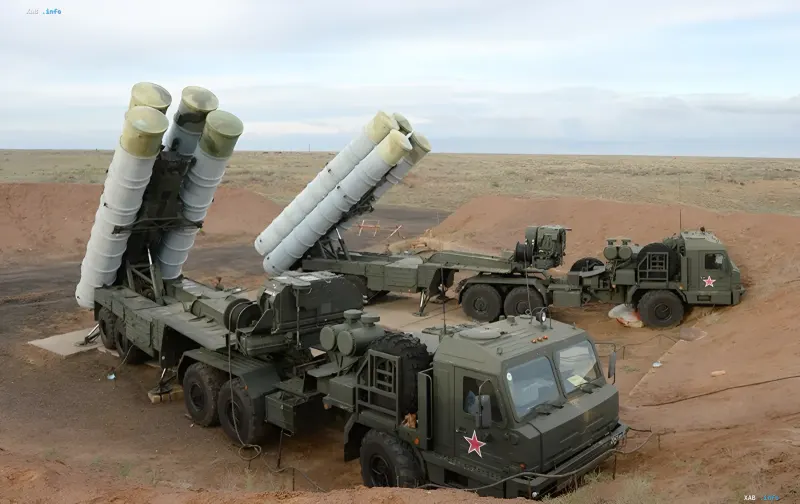
A key feature of the RM-48U, emphasized in the intelligence report, is its conveyor-style assembly from components of different air-defense missile modifications. The solid-fuel engine is borrowed from the 48N6DM air-defense guided missile, part of the S-400 system. The tail section and the equipment section (blocks R9 and U9) are taken from the export modification 48N6E2, used in the S-300 PMU1/2 and S-400 systems. Such a "mosaic" layout allows Moscow to rapidly expand its stock of strike missiles without the need to develop a completely new product from scratch, using air-defense missiles already in storage and in reserve, including decommissioned ones destined for disposal. In photos published in open sources, S-400 launchers with their characteristic four-tube containers can be seen, deployed on an open pad in an arid landscape — a typical configuration for tactical missile groups assigned to strike tasks.
Electronic Component Base: 95 of 117 Parts Are American
Intelligence has documented in detail the origin of the missiles' electronic components. Of the 117 identified blocks and elements, 95 (almost 81%) were made in the United States, 4 in Taiwan, 3 in Switzerland, 2 each in Germany, the Netherlands, Japan, and South Korea. Among the new findings, GUR noted a laser diode produced by the French company 3SP Technologies. According to Ukrainian analysts, this component-base structure confirms that Russian weaponry remains critically dependent on Western and Asian semiconductors and electronic units, despite years of sanctions. This creates additional vulnerabilities in supply chains and potentially opens up opportunities for export control and tracking of component batches.
Special Missile Groups and Tactics of Employment
To use air-defense missiles against ground targets at tactical and operational depth, Russia has formed two types of units. The first is a special tactical missile group employing the RM-48U with radio-command guidance. Its range is limited by the radio horizon and the illumination and guidance radar capabilities of the S-400 system, which significantly narrows the effective strike zone. The second is a special operational missile group (SORG), using the same RM-48U but predominantly in autonomous guidance mode based on satellite coordinates. It is precisely the autonomous missiles, according to GUR, that the adversary most often employs, because satellite guidance removes the radio-horizon limitation and allows striking targets at the full stated range of 400 km. According to Ukrainian intelligence structures, up to 17 S-400 launchers have been converted for strike use, and the stock of corresponding missiles allows for systematic attacks.
Contradictory Data
The published information comes exclusively from intelligence reports of the GUR of the Ministry of Defense of Ukraine and has been neither confirmed nor refuted by Russian military leadership. Moscow has not commented on either the existence of a separate nomenclature of "ballistic" missiles based on air-defense ones, or the specific characteristics of the RM-48U. The term "ballistic missile" applied to a modified air-defense missile is, strictly speaking, non-classical: the vehicle flies along a ballistic trajectory, but its origin, design, and guidance system remain those of an air-defense missile. In addition, the same intelligence reports mention a parallel development — the modernized "Iskander-1000" ballistic missile with a range of up to 550 km — indicating that several programs to expand the nomenclature of strike means are being pursued simultaneously. The difference in range (400 km for the RM-48U versus 550 km for the "Iskander-1000") and in design principle makes these missiles complementary rather than duplicative, although the exact ratio of their use in combat operations has not been publicly disclosed by either side.
Broader Context: Experience for Allies and Arsenal Expansion
GUR emphasizes that Russia continues to systematically expand the nomenclature of strike means, adapting air-defense and other systems to strike tasks. The experience gained from employing modified missiles against Ukraine, according to Ukrainian intelligence, may be transferred not only to Russia's domestic needs but also passed on to allies — Iran and North Korea — which potentially increases the threat to regional conflicts in other parts of the world. Against the backdrop of ongoing attacks on Ukrainian cities, including Kyiv, the use of air-defense missiles as strike weapons indicates that Moscow is exhausting part of its standard stockpiles of ballistic and cruise missiles and is forced to seek alternative sources of firepower. For Ukraine and its allies, this means the need to review air-defense and anti-missile defense systems to account for new trajectories, speeds, and types of munitions that were previously not considered within the threat framework posed by air-defense systems.