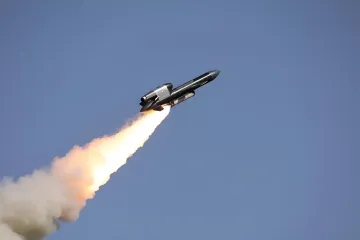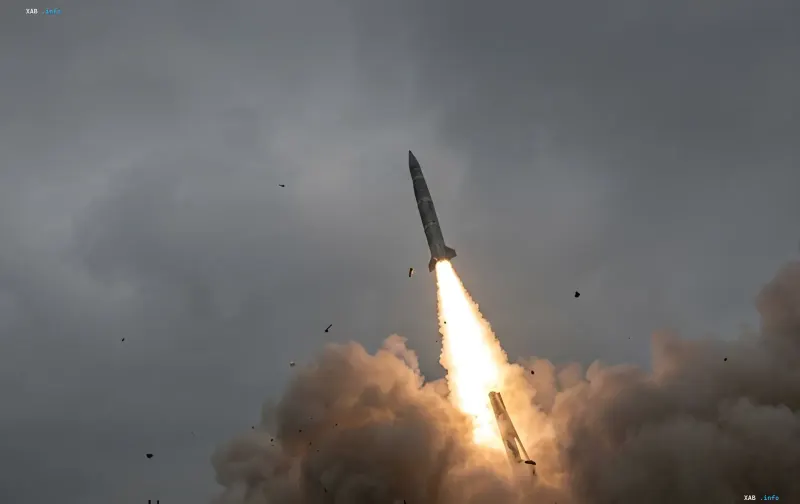
Ukrainian defense company Fire Point has moved its FP-7 ballistic missile to the military testing phase. This was announced by the company's CEO, Iryna Terekh, on the sidelines of the industry conference Photonics4Defense 2026: Technology Exchange & Matchmaking. According to her, the missile has already successfully passed two preliminary verification stages and is now in the military testing phase, which simultaneously forms part of the product codification process — that is, the procedure for formally fixing its characteristics and preparing it for serial use.
Verification Stages: From the Laboratory to Flight
As Terekh explained, the initial testing stages were ground- and laboratory-based: at them, each system and subsystem of the missile was checked in sequence, including the rocket engine and navigation equipment. The next step is flight testing, during which the missile's actual in-flight performance parameters are recorded and compared against calculated values. The company considers the completion of this cycle and the transition to military testing to be the key milestone before possible combat use.
"Not Enough Space": The Range Issue
In response to a question about timelines, Terekh acknowledged that FP-7 could move to combat use very soon. At the same time, she drew attention to an organizational problem: since this is a long-range ballistic missile and, in her assessment, Ukraine lacks the space for full-scale testing, "the second phase will probably transition smoothly into the third," and it may be "necessary to begin testing directly on the enemy." This statement effectively ties the completion of testing to the combat use of the product in real conflict conditions.
Context of Fire Point's Ballistic Program
Earlier, at the end of July, Fire Point representative Denys Shiller had published a photo of a nighttime launch of a Ukrainian missile and explained that FP-7 is positioned as a budget alternative to the American ATACMS system with a range of up to 200 km, while the more powerful FP-9 modification is capable of striking targets at a distance of 800–850 km. It was also reported at the time that FP-7's combat use could occur as early as the current year, and that the company's ballistic missiles were in the final stages of testing. In early August, it became known that Fire Point had developed its own turbojet engine, which could be used for the "Flamingo" cruise missile; according to Terekh, creating the engine proved to be a more complex task than developing the missile itself.
Contradictory Data
The company's public statements contain several inconsistencies that should be taken into account. First, at the conference Terekh describes FP-7 as a "very long-range ballistic missile," whereas in the company's own earlier public description (end of July) FP-7 is presented as an ATACMS alternative with a range of up to 200 km — that is, as a medium-range, not "very long-range," product; the ultra-long-range items in the company's lineup are the FP-9 (800–850 km). Second, the timelines for combat use are presented differently: in July it was said to be "the current year," while at the conference it was "the near future" and "weeks," with the company itself qualifying the possibility of full-scale testing by a lack of range areas and the probability of verification "directly on the enemy." These formulations reflect the management's projections rather than independently verified facts.