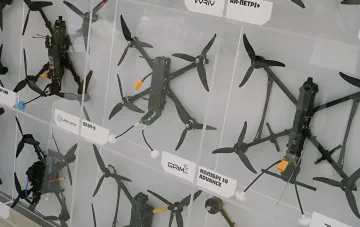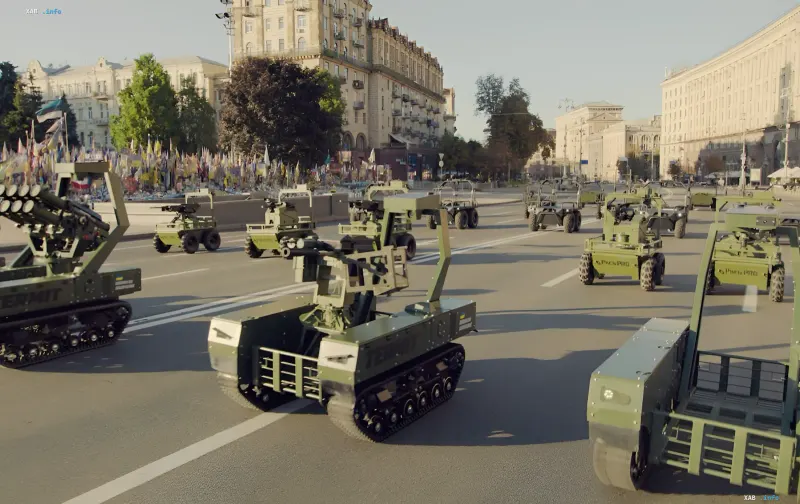
In Kyiv, as part of the celebrations marking the 35th anniversary of Ukraine's independence, the country's first-ever parade of unmanned and robotic systems was held. Thirty ground robotic complexes (GRCs) of six Ukrainian-made models rolled down the central Kreshchatyk street, while maritime and aerial drones were demonstrated over the sky and on the water. According to the organizers, a total of around 100 units of Ukrainian unmanned weaponry were showcased at the parade. The event served as a public demonstration of how deeply robotic equipment has already become a standard element of the Defense Forces' frontline logistics.
Course of the parade and the lineup of ground vehicles
According to the Office of the President, six models of complexes took part on Kreshchatyk: TerMIT, "Rys PRO" (Lynx PRO), "Simba", Ardal, "Zmey" (Snake) and Ratel. The official side emphasized that in the current year alone, Ukrainian GRCs carried out more than 66,000 missions, and the Defense Forces have contracted over 22,000 domestically produced ground robotic complexes. The parade was not merely a ceremony but, in effect, a living catalog of operational platforms, each with its own specialization — from logistics and casualty evacuation to reconnaissance and remote mine clearance.
Specifications of the six GRC models
TerMIT (manufacturer Tencore) — a tracked modular platform weighing 280 kg, capable of carrying up to 300 kg of cargo and operating for up to 12 hours without recharging; the updated TerMIT 2.0 version has a range of up to 40 km, a top speed of up to 15 km/h and can climb slopes of up to 30 degrees. "Rys PRO" (Roboneers) — a wheeled platform with a payload capacity of up to 300 kg for delivering ammunition, water and equipment, as well as evacuating the wounded; its range has been extended to 40 km, expandable to 80 km with additional batteries, and it communicates via a digital MESH network. "Simba" (UGV Laboratory) — a medium-sized logistics complex capable of traveling up to 50 km on two batteries; in spring 2026 the platform underwent testing at the NATO Crystal Arrow exercises in Latvia, where one of the complexes covered more than 1,600 km. Ardal (BUREVII) — a tracked, frame-constructed drone for logistics, evacuation, reconnaissance and mine clearance, with a range of up to 30 km and a payload of up to 200 kg, integrated with the "Burya" robotic turret. "Zmey" (Rovertech, Lviv) — an armored wheeled platform coded to NATO standards; in its logistics configuration it carries up to 500 kg of cargo, and in testing the complex covered 10 km under such a load, losing only 8% of its battery charge. Ratel X (Ratel Robotics) — a six-wheeled logistics GRC with a payload capacity of up to 400 kg, a ground clearance of over 400 mm, a speed of up to 15 km/h and a range of more than 100 km.
Maritime and aerial components of the parade
In addition to the ground robots, the parade featured a maritime fleet of nine crewless boats — Sea Baby, Magura and Sargan — performing reconnaissance, patrol and strike missions against maritime targets. In the sky, 18 interceptors (P1-Sun, Litavr and Sting) for countering "Shaheds", 27 bomber drones (Vampire, "Lazar" and Heavy Shot), eight reconnaissance drones (SHARK and LF-400) and seven long-range "Morok" drones were demonstrated. Altogether this amounted to roughly 100 units of unmanned equipment, underscoring the multi-domain nature of Ukraine's drone fleet.
Strategic context
Ground robotic complexes are increasingly becoming a standard element of frontline logistics. According to the Ministry of Defense, since the beginning of 2026, Defense Forces units have carried out more than 100,000 logistics and evacuation missions using GRCs, and the volume of contracts for purchasing such complexes has nearly doubled compared with the previous year. The parade thus marked the transition of robots from the category of experimental prototypes to that of mass-produced combat equipment, in demand at every level — from company to division.
Contradictory data
The figures on the number of missions carried out differ between the parties. The Office of the President reports more than 66,000 GRC missions "this year", while the Ministry of Defense cites over 100,000 logistics and evacuation missions "since the beginning of 2026". The discrepancy may be explained by differences in counting methodology (all missions versus only logistics/evacuation missions) and in the time windows, although no single publicly agreed-upon figure has been provided. In addition, the growing role of robots in evacuating the wounded has sparked debate: journalist Yulia Kyryienko-Merina stated that ground complexes cannot fully replace armored vehicles, and that a possible suspension of armored-vehicle purchases in favor of GRCs, in her view, puts soldiers' lives at risk. This critical viewpoint does not negate the fact that the parade was held, but it highlights the controversy over a strategy of fully replacing armored vehicles with robots.