In November 2026, the Herzogliches Museum at Schloss Friedenstein in Gotha (Thuringia, Germany) hosted an event that German and international media dubbed "the most sensational art detective story of recent decades." Five oil sketches by Peter Paul Rubens, painted on oak panels measuring approximately 48–50 cm in height and 63–65 cm in width, have been brought back together under one roof. These works had not seen each other for over 80 years: following the partition of the collection in 1945, their fates diverged across three continents—from Moscow to New York and Zurich. The exhibition "Rubens in Gotha: Loss and Return" is the result of years of searching, diplomatic negotiations, and legal procedures.
The Antwerp Commission and the 1718 Fire
The history of the five sketches begins in 1620, when Rubens, already recognized as one of the leading masters of European Baroque, signed a contract with the Jesuit order to create a monumental cycle of 39 saintly images and biblical scenes for the ceilings of the Church of Charles Borromeo in Antwerp. According to the contract, the painter personally produced the sketches, while the transfer of the compositions to the church ceiling was entrusted to other masters. In 1718, a lightning strike caused a fire that completely destroyed the pictorial cycle. Only Rubens's own preparatory sketches survived the large-scale project. Five of them were acquired in subsequent decades by the Duke of Saxe-Gotha for the collection of Schloss Friedenstein, which still towers over the city of Gotha today.
The 1945 Split: Trophies and Secret Sale
After the end of World War II, the collection was divided. The sketches "Saint Athanasius Trampling on Arius" and "Saint Basil" were taken by Soviet troops to Moscow as war trophies. The first depicts Saint Athanasius of Alexandria trampling on the defeated Arius, a theologian whose views led to the largest schism in early Christianity. The second shows Saint Basil in full height in episcopal vestments and a mitre, intently reading an open book; behind him are a twisted "Solomon" column and a soaring angel. A separate artifact related to this history is kept in the Hermitage: its graphic arts department houses Rubens's original preparatory sketch for the Saint Athanasius panel, executed in black chalk on paper.
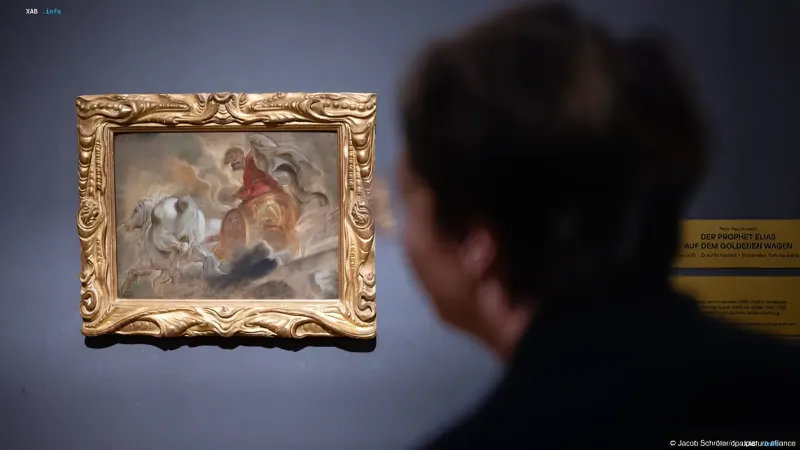
The path of the other three works—"Saint Augustine," "Saint Gregory of Nazianzus," and "The Prophet Elijah on the Golden Chariot"—proved far more complicated. The ducal family of Saxe-Coburg and Gotha secretly transported them to their ancestral castle in Coburg, formally justifying the move as necessary to save them from the advancing Red Army. However, these sketches did not return to Gotha: in 1951, they were illegally sold through American art dealers in New York. The sketch "Saint Augustine" depicts him in rich episcopal vestments, gazing at a flaming heart in his hand; "Saint Gregory of Nazianzus" pierces an anthropomorphic figure personifying heresy with his pastoral staff; and the Prophet Elijah, dressed in bright red robes with his cloak billowing, charges through swirling dark clouds toward divine radiance.
The Road Home: From GDR Return to Deals in the US and Switzerland
The two sketches taken to Moscow were returned to the Gotha museum in 1958 as part of a large-scale GDR program for the return of cultural property. The situation with the remaining three works was significantly more complex. The first step toward reuniting the collection was taken in 2024, when the American Buffalo AKG Art Museum agreed to return "Saint Gregory of Nazianzus." The sketch "The Prophet Elijah on the Golden Chariot" was purchased in the US from a private owner; the exact amount of the transaction was not disclosed, but the Ernst von Siemens Art Foundation, which financed the purchase, described it as being in the "low million range." "Saint Augustine" returned to Germany on long-term loan from the Emil Bührle private collection in Switzerland.
Exhibition for the 450th Anniversary of Rubens
The display of the collection coincides with the celebration in 2027 of the 450th anniversary of Peter Paul Rubens's birth. Representatives of the Siemens Foundation and other participants in the multi-year history of the sketches' return expressed satisfaction that the masterpieces are once again accessible to the public at the Herzogliches Museum Gotha. For Thuringia and the German museum landscape, the reunification of the five works, scattered for eight decades, has become not only a restoration triumph but also a symbolic act: a collection that lost its integrity amid the geopolitical upheavals of the mid-20th century has recovered it in an era when issues of cultural restitution are once again at the center of international discourse.