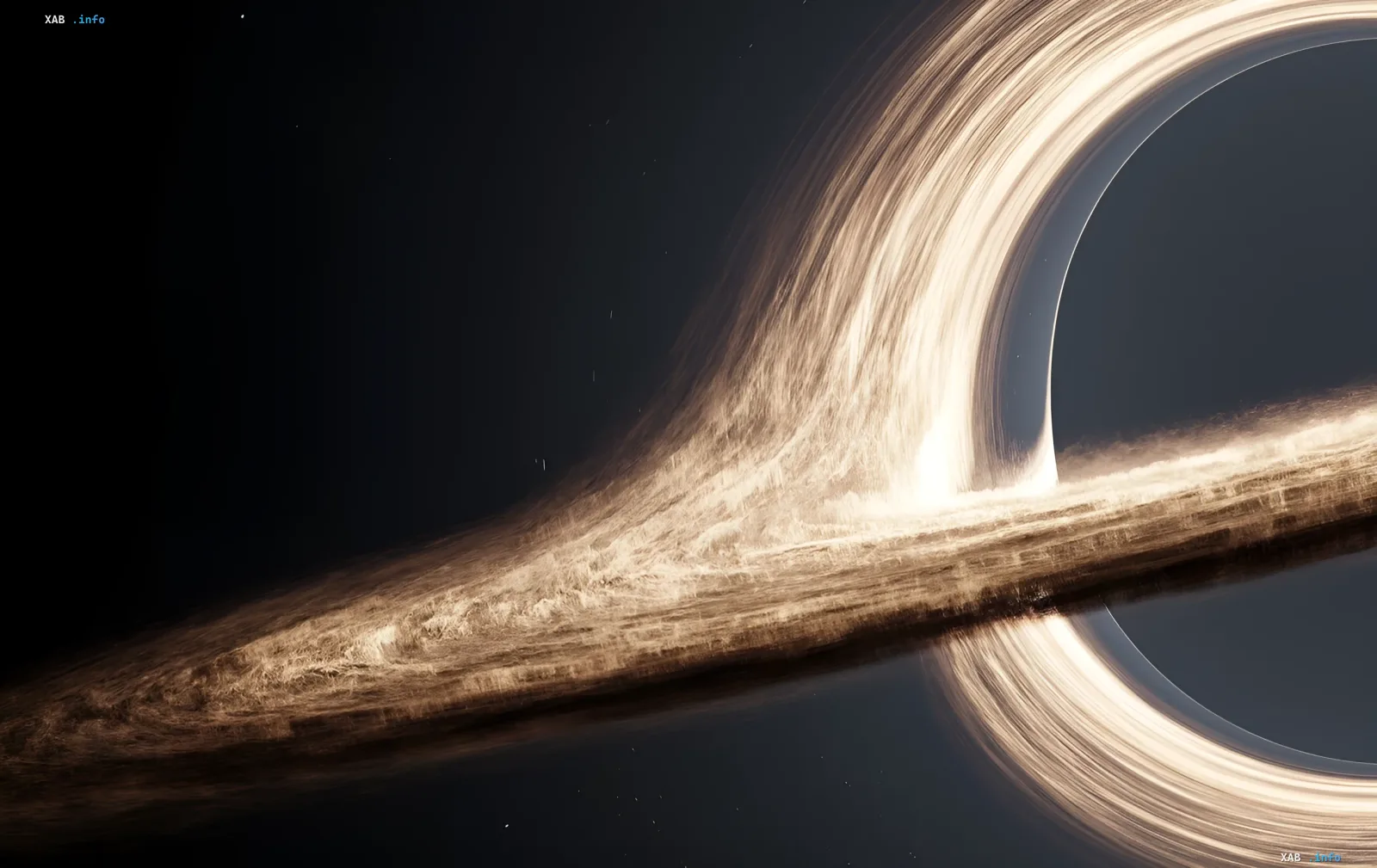
Black holes remain one of the most intriguing mysteries of modern physics. For a long time, astronomers could only observe these objects from a distance, but now scientists are proposing a radical change in approach: sending a spacecraft to a black hole.
The initiative belongs to Cosimo Bambi from Fudan University in Shanghai. His scientific work, published on the arXiv preprint server, describes a technically complex but theoretically feasible scenario for an interstellar expedition.
Mission Goal: Invisible Giants
The closest known black hole to Earth — Gaia BH1 — is located in the constellation Ophiuchus, at a distance of about 1,560 light-years. It was discovered only due to its gravitational influence on a companion star. However, according to researchers' estimates, there could be up to 100 million stellar-mass black holes in the Milky Way, most of which remain invisible.
Scientists propose searching for such objects by detecting radiation generated when they absorb gas from interstellar clouds. If a suitable target is found at a distance of 20–25 light-years, it poses no threat to the Solar System but opens up a unique opportunity for direct study.
Laser Instead of Rockets
Conventional chemical rockets cannot handle such a task due to the "tyranny of the rocket equation" — the flight would take thousands of years. The only realistic solution is considered to be the use of a solar sail accelerated by a powerful laser.
A ground-based or orbital laser could accelerate a miniature probe to one-third the speed of light in just 17 minutes. At such a speed, the journey to the target would take between 60 and 70 Earth years.
Lightning Mission
It is impossible to slow down the spacecraft upon approach, so the mission will take the form of a fast flyby. In a matter of minutes, the probe must collect the maximum amount of data and send it back to Earth — the signal will reach us another 20–25 years later.
The entire expedition will last from 80 to 100 years — exceeding the career span of the scientists and engineers who will initiate the project.
Engineering Challenge
Currently, humanity does not possess the necessary technologies: gram-scale chips cannot withstand decades of radiation exposure, and ultra-powerful lasers and sails are still in the theoretical development stage. However, scientists consider these problems purely engineering ones.
International working groups are already forming to create the necessary equipment. A major conference dedicated to the first flight into a black hole is planned for the summer of 2027.