For more than a thousand years, astronomers have faced the same enigma: in ancient catalogs, the star Theta Eridani was described as an object of incredible brightness, incomparable to what we see today. For a long time, this discrepancy was considered a simple scribal error or confusion with another star. However, a new study published on the arXiv preprint server has finally provided a physical explanation for this phenomenon.
Ancient Errors or a Real Phenomenon?
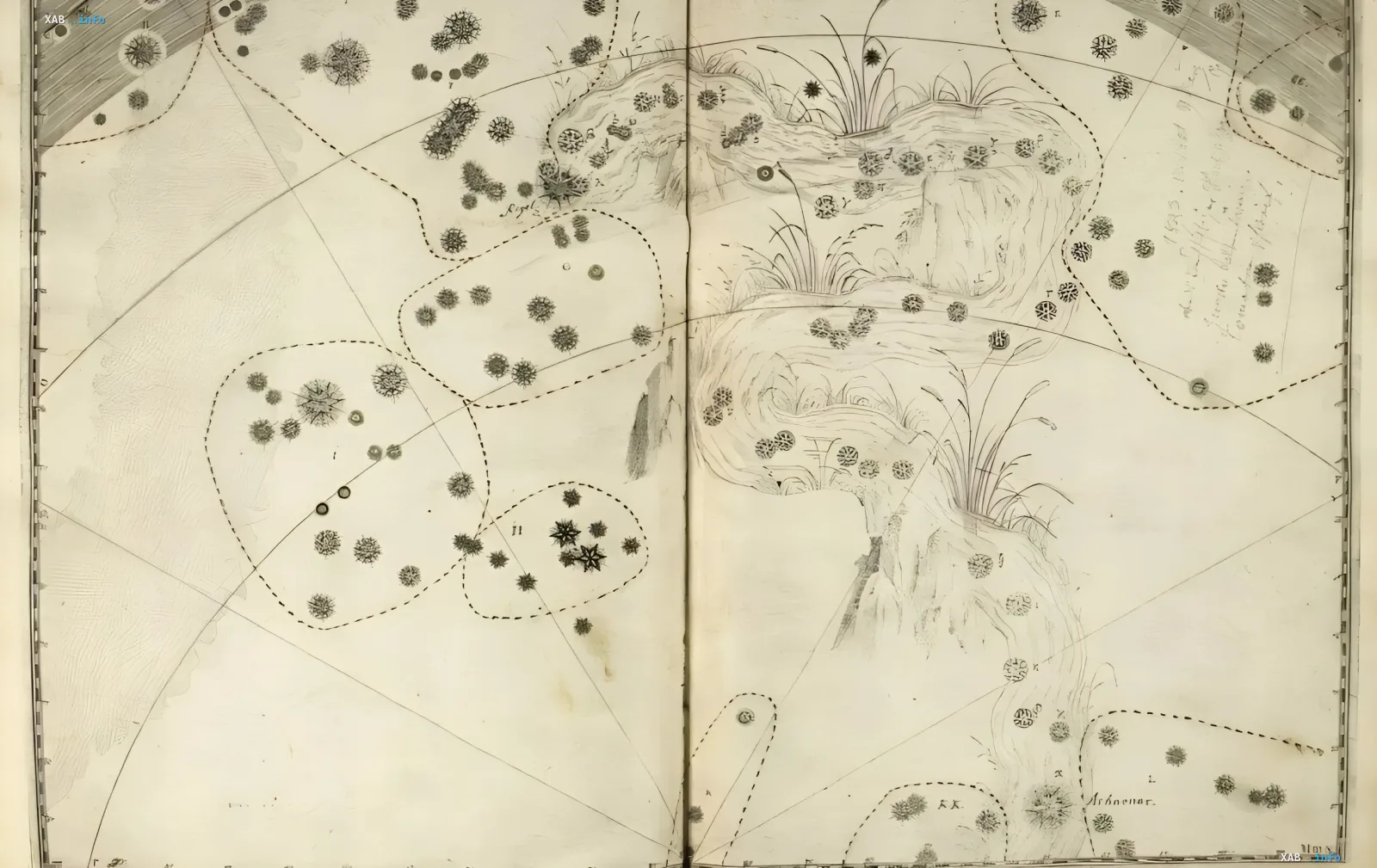
Historical records clearly indicate that Theta Eridani was once one of the most prominent objects in the night sky. As early as 129 BC, the ancient Greek astronomer Hipparchus described it as the brightest and southernmost star in the constellation Eridanus. Two centuries later, Claudius Ptolemy included it in the list of the 13 brightest stars in the entire sky in his fundamental work, the "Almagest".
Even in 964 AD, the Persian scholar al-Sufi attributed the first stellar magnitude to the star. A cardinal shift occurred only in 1603, when the Dutch navigator Frederick de Houtman compiled a new catalog of the southern sky. In it, he classified Theta Eridani as a third-magnitude star—a characteristic that fully corresponds to its modern state.
For a long time, the scientific community leaned towards the version that ancient astronomers simply confused Theta Eridani with its much brighter neighbor—Alpha Eridani (Achernar). However, modern calculations refute this hypothesis: ancient observers saw reality as it was.
A Triple System and an Evolutionary Outburst
Modern observations have confirmed that Theta Eridani is not a single star, but a complex triple system. Its core consists of a tight inner pair of stars with masses of about 2.3 and 2.2 solar masses. They orbit at a critically close distance—only 0.083 astronomical units from each other. For comparison, this is only one-fifth of the distance from Mercury to the Sun.
It is precisely this proximity that became the key to the solution. At such a distance, a star's own gravitational influence ceases to hold its matter, and it begins to flow onto the neighboring object. The more massive star of the system recently completed hydrogen burning in its core and is currently in a transitional evolutionary stage.
Ten Times Brighter
New models by astrophysicists show that between 2000 and 1000 AD, Theta Eridani indeed shone visually ten times brighter than it does now. This is explained by large-scale evolutionary processes within the close binary system, which temporarily intensified its glow. Thus, the records of Hipparchus, Ptolemy, and al-Sufi were not errors, but an accurate reflection of the star's state during that historical period.