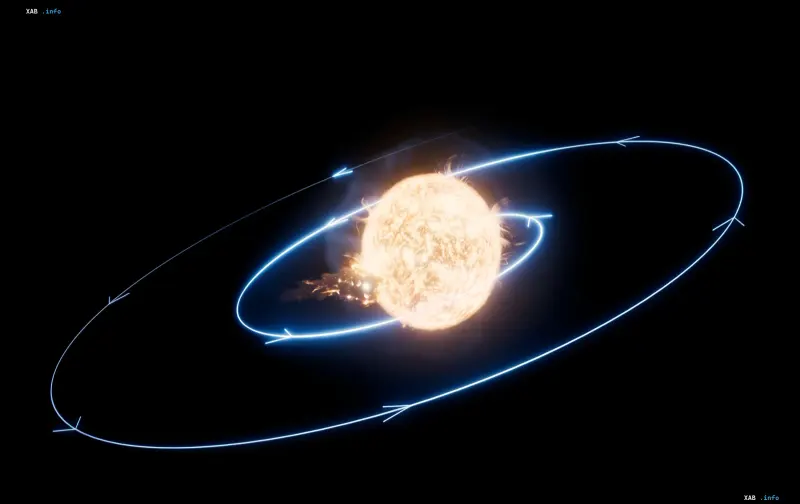
Astronomers from Turkey published a study in the journal Monthly Notices of the Royal Astronomical Society proposing a hypothesis: in the early phase of its existence, the Sun swallowed a planet whose mass exceeded that of Earth by a factor of 5–10. According to their calculations, this event left chemical and structural 'fingerprints' in the star's interior, which persist to this day and can be verified using helioseismological measurements.
An Unfinished Puzzle: What the Models Could Not Explain
For many years, standard physical models of stellar evolution have failed to fully reconcile theoretical predictions with actual seismic observations of the Sun. In particular, discrepancies were recorded in the speed of sound beneath the convective zone and in the depth of the convective zone itself. Meanwhile, the mystery of the anomalous depletion of lithium on the star's surface remained unsolved — its concentration turned out to be significantly lower than classical models predicted. The researchers suggested that both problems share common roots in the Sun's early chemical history.
MESA Computer Modeling: How the Planet Dissolved Into the Star
Using the MESA stellar evolution modeling package, the scientists tested various scenarios of matter accretion and compared the results with actual observations. According to the model, the planet was able to pass through the star's outer layers, losing only a negligible fraction of its own mass, before dissolving completely into the interior. Because planets form from material that is chemically distinct from the gas of the protoplanetary disk, the absorption of such a solid body should have left a noticeable trace in the star's chemical composition and internal structure. The authors emphasize that the proposed scenario simultaneously explains both the peculiarities of the Sun's internal structure and the anomalously low concentration of lithium.
Why the Solar System Has No Super-Earths
Astronomers have long wondered why large super-Earths are detected in many other stellar systems, yet are absent from the Solar System. Earlier hypotheses suggested that one or several such planets could have formed inside Mercury's orbit and then migrated inward through the gas disk toward the Sun. The new work by Turkish scientists goes further: it not only confirms the theoretical migration pathway but also points to the existence of direct physical evidence of such an event, which can now be tested with helioseismological measurements.
Contradictory Data
In the headline of the RBC-Ukraine publication, which references the same study, the wording 'a planet 10 times larger than Earth' appears, whereas in the text of the scientific work itself and in the extended version of the report the range is given as 5–10 Earth masses. The difference between the upper bound of the range and the point value in the headline could mislead the reader about the precision of the estimate. Moreover, the source fraza.com, mentioned in the context, is devoted to the discovery of another super-Earth with potential conditions for life and is not a direct confirmation of the hypothesis about the Sun swallowing a planet; it is used only as general context about the prevalence of super-Earths in the Universe.
What's Next: Verification Through Helioseismology
The key significance of the work lies in the fact that it moves the hypothesis from the realm of pure speculation into the domain of testable predictions. The authors note that helioseismological measurements, already being carried out within the framework of the Solar Orbiter mission and future projects, are capable of either detecting or refuting the predicted structural anomalies. If the data confirm the model, this will become the first direct evidence that the Sun once 'swallowed' planets, and will open a new class of archaeological evidence in heliophysics.