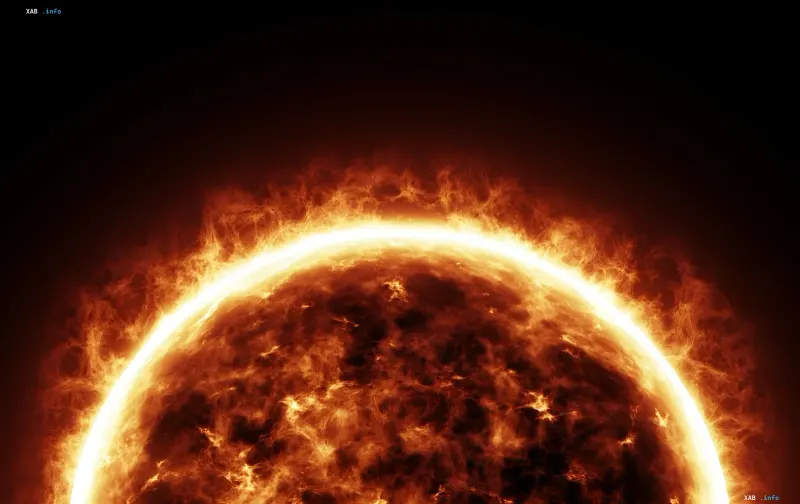
On August 14, 2026, the scientific community marks a significant milestone in heliophysics. Thanks to data from the Indian spacecraft Aditya-L1, launched two years ago, scientists have finally clarified the mechanism maintaining the extremely high temperature of the solar corona. For a long time, astrophysicists debated why the Sun's outer atmosphere, far from the core, heats up to millions of degrees, while the visible surface (photosphere) has a temperature of only about 5500 °C.
Dominance of Magnetic Reconnection
A new study, based on observations of a powerful coronal mass ejection (CME) that occurred on August 5, 2024, provided irrefutable evidence. Astrophysicists analyzed the operation of two hypothetical heating mechanisms: wave and magnetic. It turned out that the wave mechanism, where energy is transferred from the "boiling" movements on the surface, contributes only 7% to the total heating.
The key role, accounting for 93%, is played by the process of magnetic reconnection. In the Sun's atmosphere, magnetic field lines constantly tangle and twist. When they break and reconnect, a powerful reconfiguration of the system occurs, releasing a huge amount of energy. It is this process that heats the corona to 2 million °C.
The Sun's Self-Restoration Mechanism
The solar corona is the site of extreme cosmic phenomena — flares and mass ejections. During such events, huge volumes of magnetic plasma fly into space. If this lost energy were not compensated, the Sun would gradually deplete, eventually leading to the freezing of Earth.
Observations using the Velc (Visible Emission Line Coronagraph) coronagraph on board Aditya-L1 showed that the Sun possesses a clear internal mechanism for updating its balance. Ten hours after a powerful ejection, the broken and tangled magnetic field lines returned to their original position, restoring the energy state of the corona. This discovery provides a fundamental guide for understanding the life cycle of our star.
Impact on Earth and Technology
Understanding these processes is critical for forecasting space weather. Coronal mass ejections can cause geomagnetic storms on Earth, disrupt power grids and communication satellites, and create auroras. During periods of low activity, the Sun produces 2-3 ejections a day, while during the peak of the 11-year cycle, their number can exceed 10 per day. Data obtained in 2024 allows for building more accurate models to predict these events in 2026 and beyond.